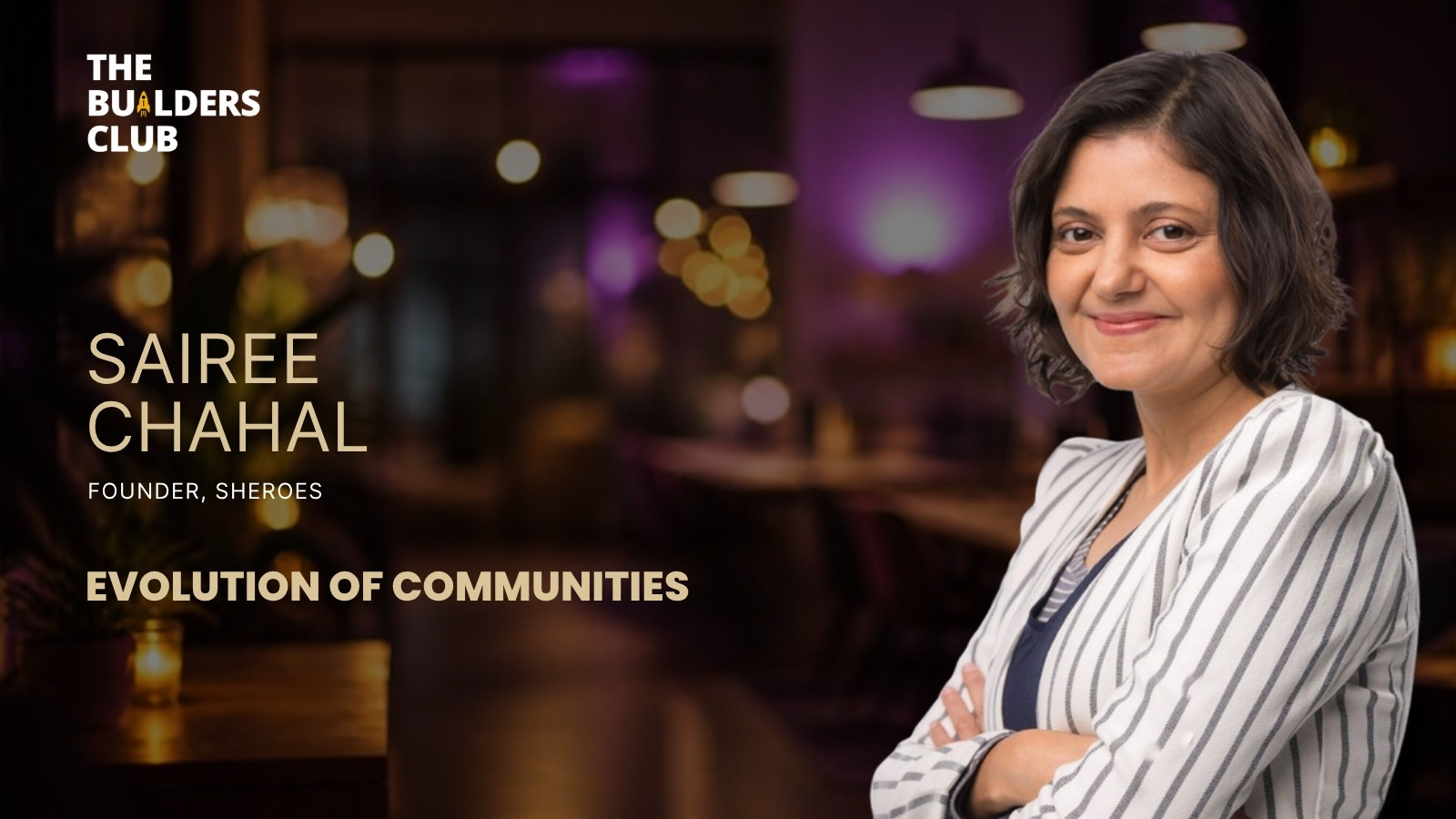
Most social platforms chase virality. Sairee Chahal chose the opposite: trust. As founder and CEO of SHEROES, she built a women-only community platform that she says reached about 22 million users by prioritizing safety, depth and real outcomes for women.
In this Builders Club water cooler conversation, Sairee traces her path from building her first startup in college in 1999 to running one of India’s largest communities for women.
How do you build a women-only community platform? Sairee Chahal’s core thesis
Sairee’s thesis is that a community lives or dies on trust. SHEROES grew by designing a safe space, avoiding programmatic ads, and measuring whether women’s lives improve rather than counting daily actives.
She also builds as a platform, not a content house. Women create the communities and the content, the team builds the tools, and users help set the norms.
- Trust beats virality. She argues you can be popular or trusted on the internet, and chose trust.
- Measure depth. Retention over long periods, lifetime active days and a trust score matter more than DAU and MAU.
- Monetize in line with users. Remote work, brand partnerships and peer-to-peer commerce, not programmatic ads.
- Platform, not publisher. No content team; communities are micro-apps run by users.
What is Sairee Chahal’s entrepreneurial journey?
Sairee built her first startup in 1999 while still in college. Newslink was described as the world’s first newspaper for mariners, compressing news into tiny files that could be beamed to merchant ships by satellite and sold as a subscription per sailor per ship.
She later ran Scita, which helped tech startups scale, then Flexi Moms, a precursor to SHEROES. SHEROES began as a jobs and careers community for women and was relaunched in 2018 as a women-only social network.
- 1999: Newslink, selling to a large share of the shipping industry.
- 2006: Scita, working with tech startups on scaling.
- Flexi Moms, then SHEROES focused on keeping women in the workforce.
- 2018: relaunch as a women-only social network.
Why did SHEROES pivot to a women-only network?
Sairee grew up in a village in Muzaffarnagar and noticed how few women were in the room throughout her career. After having her daughter the year she started Scita, she took her to work and client meetings and felt the gap herself.
By 2016-17, women outside the big metros were reaching the platform. The 2018 relaunch focused on two themes: emotional progress through a safe space for expression, and financial independence.
What does the product look like?
She describes it as a network of communities, inspired by Reddit. Each community behaves like a micro-app that can be branded and customized without an app store update, and users can create their own, with about 2,700 user-run communities at the time.
How does technology build trust in a community?
Sairee says everything is built on tech, even if it looks like conversation. Many users are first-time internet users who mostly know WhatsApp, so safety and simplicity are central.
Trust is baked in through product decisions rather than slogans.
- Selfie verification and a gender detection check at sign-up.
- Spam and abuse controls with a report mechanism.
- A counseling helpline with notes carried between counselors; she says almost two million women have used it.
- Vernacular language support and gamification such as badges and leaderboards.
How does SHEROES make money without programmatic ads?
The team decided against programmatic ads because they distract from the purpose, and because asking first-time internet users for subscription money did not fit. Monetization has to benefit women directly.
She described several streams, with peer-to-peer commerce as the bet for scale.
- A certified remote work community of about 10,000 women working for large companies.
- Brand partnerships where there is synergy, such as a rural women’s accelerator and projects with large companies.
- Peer-to-peer commerce, a social store where everyone can buy and sell.
- Possible membership fees in the future.
How should you measure the health of a community?
This was a long debate with her investors, who wanted DAU and MAU. Sairee prefers to measure depth, because the internet measures virality far better than trust.
Her test is whether a user would volunteer for you, or miss you if you went away. During Covid, about a thousand women signed up to volunteer on a helpline for months.
- Long-term retention: she cited roughly 70 percent at day 30 and 55 percent at day 180.
- Total active days over a user’s lifetime.
- A SHEROES trust score that captures social capital.
- Outcome metrics such as women who earned or made a sale.
How do you grow a community without buying users?
Sairee says virality is a killer of trust, and that you can buy an audience but not a community. Early growth came from the helpline, relationships with women’s organizations such as self-help groups and women’s colleges, and partnerships.
She advises community builders to know their why, walk in the user’s shoes and protect the vibe. For SHEROES, the vibe is confidence-inducing, never confidence-reducing.
Further reading and sources
Frequently asked questions
How do I build trust in an online community?
Sairee’s approach was to invest in safety and real support before growth. SHEROES uses verification at sign-up, spam and abuse controls, clear community guidelines and a counseling helpline. She argues these choices matter more than viral growth tactics.
What metrics should a community track instead of DAU and MAU?
Sairee suggests measuring depth: long-term retention, lifetime active days and outcomes such as income earned. SHEROES also built an internal trust score. Pick metrics that show whether members’ lives improve.
Can a community monetize without ads?
Yes, according to Sairee. SHEROES earns through a remote work program, brand partnerships and peer-to-peer commerce rather than programmatic ads. The key is that monetization should directly benefit members.
Conclusion
Sairee Chahal’s message is that communities are built on trust, not traffic. Be clear on your why, know your users deeply and design the product so that safe behavior is the default.
This week, pick one depth metric for your own community and track it alongside your usual numbers.
Want more conversations like this? Join The Builders Club, our community of 35,000+ founders and CXOs, and explore more episodes of the Startup Founders Podcast.