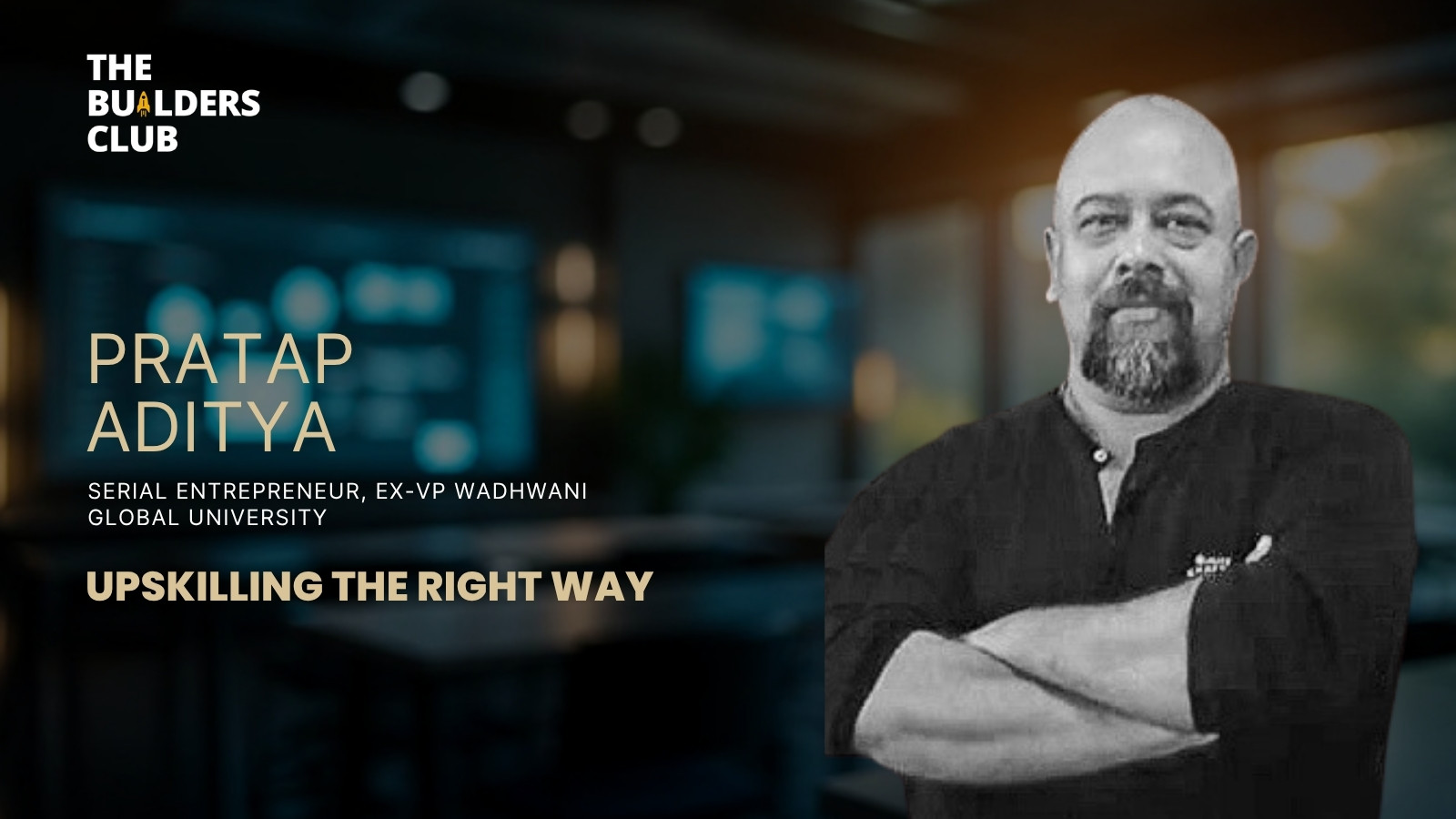
Pratap Aditya ran his first venture at 15 by making mixtapes, later built businesses across India and Nepal, and went on to lead learning and capability work at scale. His view on skills is blunt: training is a means, never the end.
In this episode of The Builders Club Startup Founders Podcast, he explains how to upskill yourself and your team the right way, and why a clear sense of why outlasts any failure.
What is the right way to upskill? Pratap Aditya’s core thesis
Pratap argues that real capability comes from three things working together: training that builds a person’s belief in their own ability, a real opportunity to perform, and an environment that supports them. Remove any one and performance suffers.
Underneath all of it sits the why. Methods, tools and technology keep changing, but the reason you are learning or building a business is what keeps you going when things break.
- Start with why, then how, then what. Clarity of purpose drives the choices that follow.
- Favour vocational skills. Academic education builds foundations, but doing the job needs practised skill.
- Build self-efficacy. Let people try, fail and try again in a safe environment.
- Use a hybrid learning architecture. Blend curated online content, coaching, and one-to-many training.
Who is Pratap Aditya and what shaped his view on learning?
Pratap started selling mixtapes and handmade greeting cards as a teenager, studied hotel management, and ran a catering business. He then spent months in Nepal helping operate small hotels before returning to India.
He moved into learning and development in the early 2000s, working on projects for large financial and retail organisations and building a corporate university for seven years. Later he started an edtech venture and a vocational training business that spread across 129 cities.
That business eventually failed, and he lost much of what he had built. He later joined the Wadhwani Foundation as global head of its corporate university, training educators and entrepreneurship trainers in about 21 developing countries, and then moved to lead capability development at HCL Technologies.
What three lessons does Pratap give founders?
He compresses his career into three lessons for entrepreneurs and leaders. They apply equally inside large companies.
- Treat failure as inevitable, take it in your stride and come out stronger.
- Always know why you are doing what you do: why first, then how, then what.
- Build a team around alignment of thought, not friendship or family ties.
Why does he prefer vocational skills over purely academic learning?
Pratap’s early work with rag pickers taught him that standard education approaches often fail when they ignore people’s real motivations. He later concluded that learning has to translate into doing the job.
He sees academic education, such as an MBA or an engineering degree, as building wisdom and a systematic way of thinking. But when it comes to execution, he looks for people with practised vocational skills.
As a hirer of engineers, he says he looks less at specific technical content and more at whether four years of study taught the person to think systematically.
- Academic learning builds the foundation
- Vocational learning builds job-ready capability
- Hire for attitude, aptitude and systematic thinking
Is technology a substitute for teachers and trainers?
Pratap’s answer is that technology is a strong support mechanism, not a replacement. How people consume knowledge has changed, because information is available instantly, and the roles of tomorrow may not exist today.
What has not changed is the reason people learn: to earn, grow or follow an interest. He recommends a hybrid learning architecture that blends curated platforms such as Coursera and YouTube with one-to-one and one-to-many training and coaching.
He gives a simple test: you would not want a surgeon who only learned from videos.
What should a learning plan include?
For your team, decide which parts can be self-learned, which need instructor-led training, and which need coaching.
- Curated online resources
- Instructor-led training
- Coaching for individuals
- Self-learning material
How do you build self-efficacy in a team?
Using the example of teaching a child to ride a bicycle, Pratap explains self-efficacy as belief in one’s own ability. A parent holds the bicycle, lets go, and encourages another try after a fall.
Leaders should create an environment where mistakes are acceptable and not trying is the real failure. He says this works upwards too: allow your boss and your co-founders to fail as well.
He also raised the Pygmalion effect, noting that a leader’s expectations and perceptions of people shape the results they get. His advice is to respect people in public, correct them in private and model the behaviour you want.
- Allow controlled experimentation
- Celebrate trying, not only winning
- Praise in public, correct in private
- Check your own perceptions of people
What does Pratap Aditya say about edtech opportunities?
Answering a question about competition in edtech, he stressed that India is much larger than the top few dozen districts that dominate headlines. He sees a large opening for vernacular offerings.
He urged founders to be clear whether they are building a valuation business or a legacy business, and warned that anything built on shortcuts only buys limited time.
He also reminded founders that reaching customers in smaller markets is tough, hands-on work, and that value propositions should start from the job to be done and the pains and gains of the learner.
Further reading and sources
- Wadhwani Foundation on Wikipedia
- HCLTech on Wikipedia
- Self-efficacy on Wikipedia
- Pygmalion effect on Wikipedia
Frequently asked questions
How do I build a skills development plan for my startup team?
Pratap recommends a hybrid learning architecture. Decide which skills can come from curated online platforms, which need instructor-led training, and which need individual coaching. Then give people real opportunities to apply what they learn.
Does technology replace trainers and mentors?
Pratap says no. Technology makes learning more digestible and accessible, but it supports teachers and coaches rather than substituting for them. Skills with real-world stakes still need practice and guidance.
What should I look for when hiring for capability?
Pratap looks for the right attitude, aptitude and the ability to think systematically. Specific technical content changes quickly, so he values people who can learn and apply new skills.
Conclusion
Pratap Aditya’s message is that upskilling starts with purpose and succeeds when people can practise, fail and try again in a supportive environment.
As a next step, write down your team’s why, map each skill to a learning method, and make sure every learner has a real opportunity to apply it.
Want more conversations like this? Join The Builders Club, our community of 35,000+ founders and CXOs, and explore more episodes of the Startup Founders Podcast.