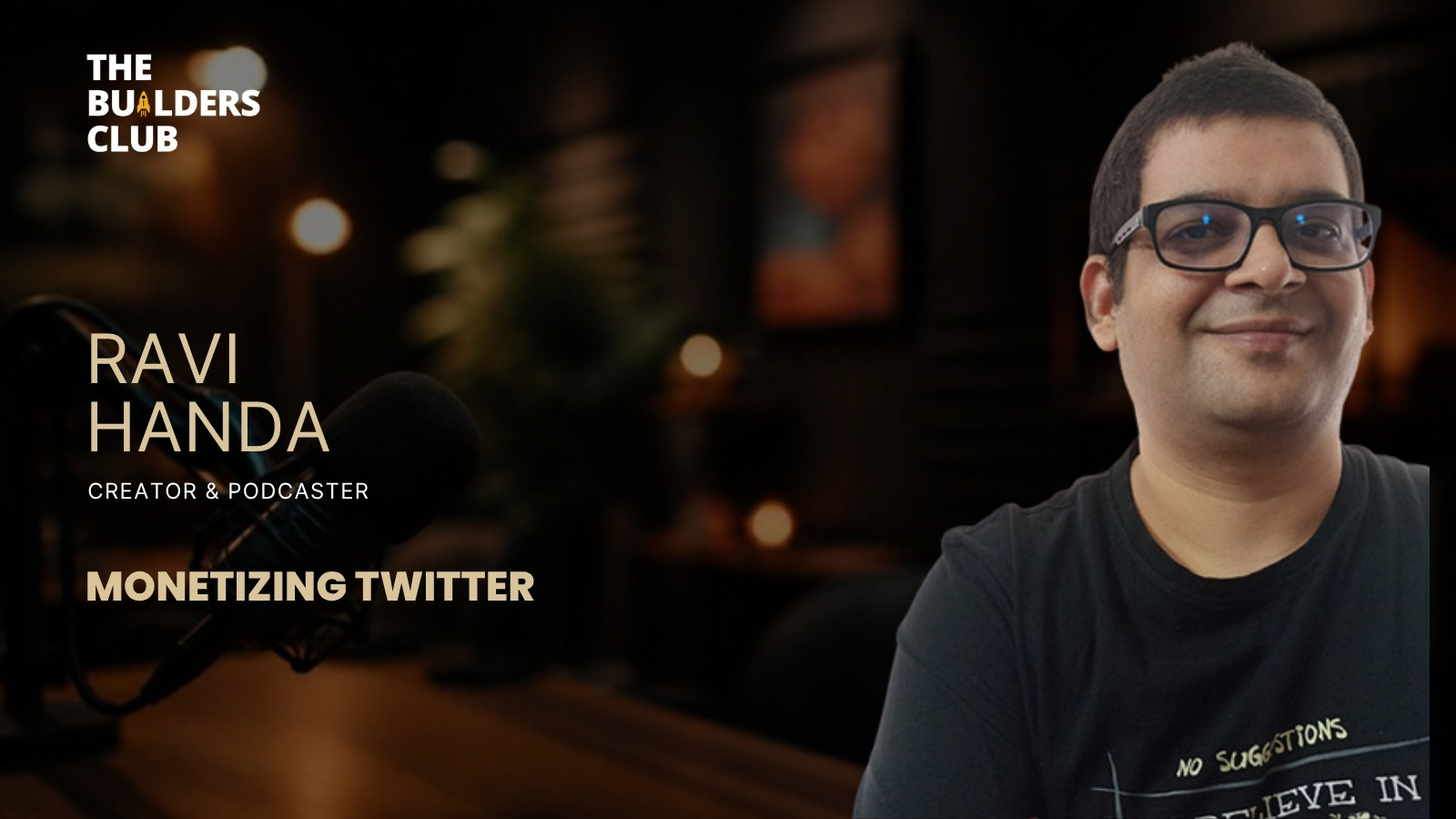
Ravi Handa has been publishing online since the early 2000s, from blogs and quizzes to online courses, and was among the first Indian creators to see money flow from Twitter.
In this episode of The Builders Club Startup Founders Podcast, the founder of Handa Ka Funda and host of The Desi FIRE Podcast explains monetizing Twitter in plain terms: what the platform rewards, what it pays and where creators should be cautious.
How does monetizing Twitter actually work? Ravi Handa’s core view
Ravi’s answer is that Twitter’s payout programme is built around views, and creators change their behaviour to match the metric. When monetization launched, the qualifying bar was a high number of views sustained over three months, and it was later relaxed. Followers and retweets used to be the scoreboard; now views, and especially replies, drive reach.
He is equally frank about the limits. The platform pays only a slice of what a creator can earn, the formula is opaque, and for most people content is a hobby worth enjoying rather than a career to bet on.
- Views are the metric. Payout eligibility and creator behaviour now revolve around impressions rather than follower counts.
- Replies beat retweets. For accounts under about 5,000 followers, Ravi advises optimising for replies, likes and conversation.
- Brands pay differently. Affiliate deals rarely work for mid-sized creators; flat fees do better, and YouTube earned him more per plug than Twitter.
- Treat it as a side hustle. Very few creators build a full career, so keep the day job or business running.
Why does Twitter sell less than YouTube or Instagram?
Ravi compares his own results across platforms. For the same effort, he says, video platforms such as YouTube and Instagram generate far more sales than a text-first platform like Twitter.
He gives two reasons: video persuades faster than long text, and Twitter’s audience is more questioning and discerning, so a weak claim gets cross-examined in public.
- Format: a story that takes pages of text to land can be told quickly in video.
- Audience: Twitter users tend to push back, and those replies can reach many non-followers.
- Visibility of criticism: on Twitter, critical replies and quote tweets travel; on YouTube they sit in the comments.
How does the Twitter algorithm reward creators now?
According to Ravi, the shift from followers and retweets to views changed everything. Once payouts depended on impressions, creators began chasing views above all else, including with controversial posts.
His practical advice for anyone with a smaller following is to optimise for replies, because conversations push a post back onto timelines and invite more engagement.
- Write posts that invite a response rather than a passive like.
- Reply to others, since replies carry your name into other people’s threads.
- Engage with verified accounts, because Ravi notes that views from verified users appear to matter a lot.
- Track views as your main metric, but watch quality so you do not slide into clickbait.
Is monetizing Twitter worth it for brands and creators?
Ravi says the payout rules are still unclear, and he could not tell whether his first payout represented one month or several. His own estimate was that platform money is a small fraction of what creators earn from brands.
On brand deals, he found affiliate arrangements unattractive because the sign-up volumes from a mid-sized audience rarely justify the effort. He prefers a flat fee, and found it easier to get paid for a plug in a YouTube video than on Twitter.
What should a company do with its Twitter account?
If a brand has only one person to dedicate to Twitter, Ravi says that person should handle customer support first. Replying to customers is the baseline; thought-leadership posts come after.
Why does video production quality matter more now?
Ravi last did serious video work around 2012 to 2014 and says audience expectations have moved far ahead of his own production level. People now notice lighting, sets and framing.
He believes the same conversation shot in a polished setting would attract more views, because viewers now expect a certain quality before they will sit through a full episode.
- Compare like with like: the same topic from two creators, one with stronger production.
- Improve the basics first: audio, lighting and framing.
- Choose a format that fits your budget instead of copying a studio you cannot afford.
How consistent should a creator be?
Ravi says frequency depends on content type. For his finance-focused podcast, he considers one video a week ideal, though he admitted he was averaging closer to one a month.
For a podcast like The Builders Club’s, he suggests a fixed weekly slot, promoted through the community, email list and trailers, so the audience knows when to return.
Should founders become full-time content creators?
Ravi is direct: it is a great hobby and a risky career. He argues that courses can teach hygiene factors that take you to a certain level, but talent and luck decide how far beyond that you go.
He also says Instagram is usually the easier place to reach 50,000 followers than YouTube, because short videos are easier to produce and push out in volume.
- Treat content as a side hustle alongside a real business.
- Learn the basics, but do not expect a formula to guarantee a career.
- Start where growth is easiest, then move to longer formats.
Further reading and sources
Frequently asked questions
How can I make money on Twitter as a creator?
According to Ravi Handa, eligibility and payouts are driven mainly by views, so the focus is on getting more impressions. He suggests prioritising replies and conversation, and notes that engagement with verified users appears to carry weight. Platform payouts are only one income stream; brand deals are usually larger.
Is Twitter or YouTube better for selling a product?
Ravi’s experience is that YouTube and Instagram convert better than Twitter for the same effort, because video persuades faster and those audiences are less sceptical. Twitter users tend to question claims publicly, which can hurt a weak pitch. Twitter is better suited to building connections and handling customer support.
Can content creation be a full-time career in India?
Ravi argues it is a very good hobby but a hard career, because only a small share of creators earn a steady living. He recommends treating it as a side hustle, learning the basics, and not assuming a course or formula guarantees success.
Conclusion
Monetizing Twitter is real, but Ravi Handa’s message is to approach it with clear eyes: the metric is views, replies are the lever, and the platform pays only part of the picture.
If you are a founder building a personal brand, pick one platform, keep a steady schedule, invest in basic production quality and keep your core business as the main bet.
Want more conversations like this? Join The Builders Club, our community of 35,000+ founders and CXOs, and explore more episodes of the Startup Founders Podcast.