
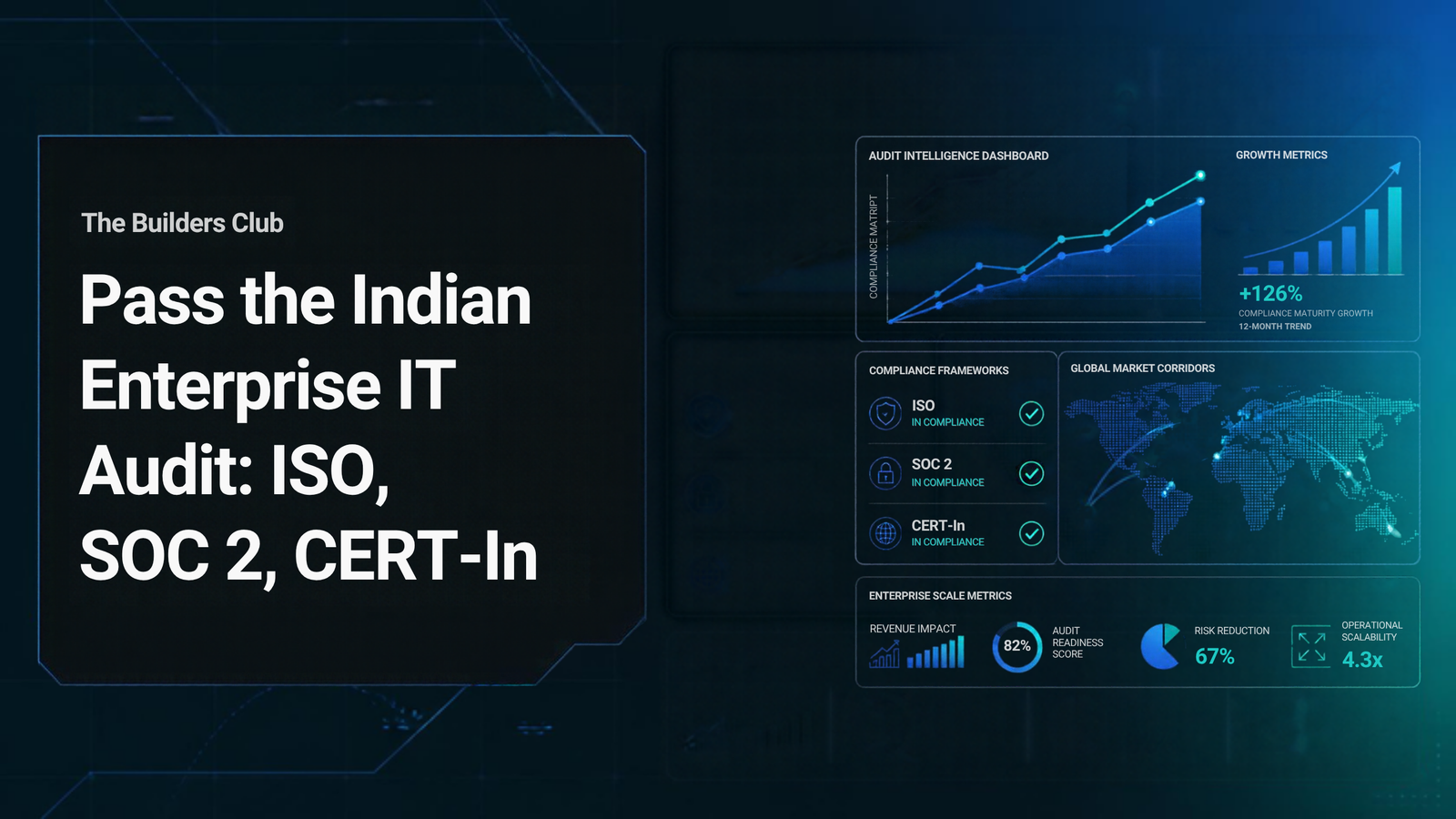
You win the business champion, the pilot goes well, and then the deal lands on the desk of the information security team. The questionnaire has 200 questions, and the first one asks for your ISO certificate.
For many Indian startups, the IT audit is where promising enterprise deals go to wait.
What is the short answer on security certifications for Indian enterprise buyers?
There is no single mandatory certificate. In practice, most large buyers expect ISO/IEC 27001 or a SOC 2 report, a recent independent penetration test, compliance with CERT-In directions on incident reporting and logging, and a clear position on personal data under India’s DPDP Act. Regulated sectors add their own requirements on top. Start with ISO 27001 and a VAPT, then add SOC 2 if you also sell to US buyers.
Which certifications do Indian corporate IT teams actually ask for?
| Item | What it shows | How commonly asked |
|---|---|---|
| ISO/IEC 27001 | An audited information security management system | Very common for Indian enterprises |
| SOC 2 Type II | Independent report on controls over a period, from the AICPA framework | Common where buyers or investors are global |
| VAPT report | Penetration test and vulnerability assessment of your application and infrastructure | Almost universal; many buyers prefer a CERT-In empanelled auditor |
| CERT-In compliance | Incident reporting, log retention and time-sync practices | Increasingly asked in questionnaires |
| DPDP readiness | Handling of personal data under India’s data protection law | Rising quickly as the rules phase in |
| Sector rules | RBI, SEBI or IRDAI requirements for banks, brokers and insurers | Mandatory for regulated buyers |
Which items are mandatory depends on the buyer and their regulator. Confirm the exact list with each customer’s security team instead of assuming.
What does CERT-In expect from you?
The CERT-In directions of April 2022 apply broadly to service providers, intermediaries, data centres and bodies corporate. The points that most often appear in vendor questionnaires are:
- Incident reporting: specified cyber incidents must be reported to CERT-In within six hours of noticing them.
- Log retention: logs of ICT systems must be maintained for a rolling 180 days and be available to CERT-In on request, with a copy held within India.
- Clock synchronisation: system clocks should sync to the NTP services of NIC or NPL.
- Point of contact: you must designate and share a contact for incident coordination.
Read the summary of the directions from ManageEngine for a practical overview, and the primary text on the CERT-In site for the authoritative wording.
How does the DPDP Act affect your audit readiness?
The Digital Personal Data Protection Rules were notified on 13 November 2025 and are being phased in. Key obligations around notice, consent, security safeguards and breach intimation are scheduled to apply from 13 May 2027, according to a legal summary of the rules. The Act places obligations mainly on the data fiduciary, so your enterprise customer will push duties down to you through the data processing agreement.
Prepare now: know what personal data you process, where it sits, who can access it and how you would notify a customer of a breach.
What is a sensible order to get certified?
- Baseline hygiene (weeks 1 to 4): single sign-on and MFA, role-based access, encryption in transit and at rest, backups, logging, vendor list.
- Policies and evidence (months 1 to 3): information security policy, access reviews, incident response plan, change management, employee training records.
- Penetration test: commission a VAPT, fix critical findings and retain the report with the remediation evidence.
- ISO 27001 audit: typically a multi-month effort including internal audit and certification audit stages.
- SOC 2: add when customers or investors ask for it. A Type II report needs an observation period, so plan for it early.
Timelines depend on company size and existing maturity. Use compliance automation tools if they help, but remember that an auditor will still ask for real evidence of real practice.
How do you handle the security questionnaire itself?
- Keep a master answer library so every questionnaire starts from approved responses.
- Prepare a security pack: certificates, pen test summary, architecture diagram, data flow diagram, sub-processor list and DR plan.
- Offer a call with your security lead early. A clear conversation often shortens a written review.
- Be accurate. Overclaiming a control that an auditor later cannot verify can end the deal and the relationship.
Frequently Asked Questions
Is ISO 27001 mandatory to sell software to Indian enterprises?
It is not a legal requirement in general, but many large buyers ask for it as part of vendor onboarding. Where you lack it, some buyers accept a detailed questionnaire, a penetration test and a remediation roadmap, though this usually lengthens the review.
Do I need both ISO 27001 and SOC 2?
Not necessarily. For a company selling mainly to Indian enterprises, ISO 27001 typically carries more weight. If you also sell to US customers or work with global investors, a SOC 2 report is commonly requested, and the overlap between the two frameworks reduces the extra effort.
What does CERT-In require from a SaaS vendor?
The 2022 directions require reporting specified incidents within six hours, keeping ICT logs for 180 days with a copy available in India, synchronising clocks to NIC or NPL time sources and nominating a point of contact. Check the current text and your specific obligations with legal counsel.
Conclusion
Passing an Indian corporate IT audit is a matter of preparation, not luck. Build the basics early, get an independent VAPT and ISO 27001, track CERT-In and DPDP obligations, and keep a ready security pack. Doing this before you need it turns the audit from a six-month delay into a routine step.
This article is general information, not legal or compliance advice. Confirm requirements with your counsel and each customer’s security team.
If you are building a B2B company for Indian enterprise buyers, join The Builders Club community to compare notes with other founders and CXOs who are working through the same problems.
About the author: Sohail Khan is the Founder and Director of The Builders Club, a professional community of 35,000+ founders and CXOs across India, the UAE, Singapore and the US. He writes about enterprise go-to-market, sales and scaling for B2B founders.