
// ARTICLE

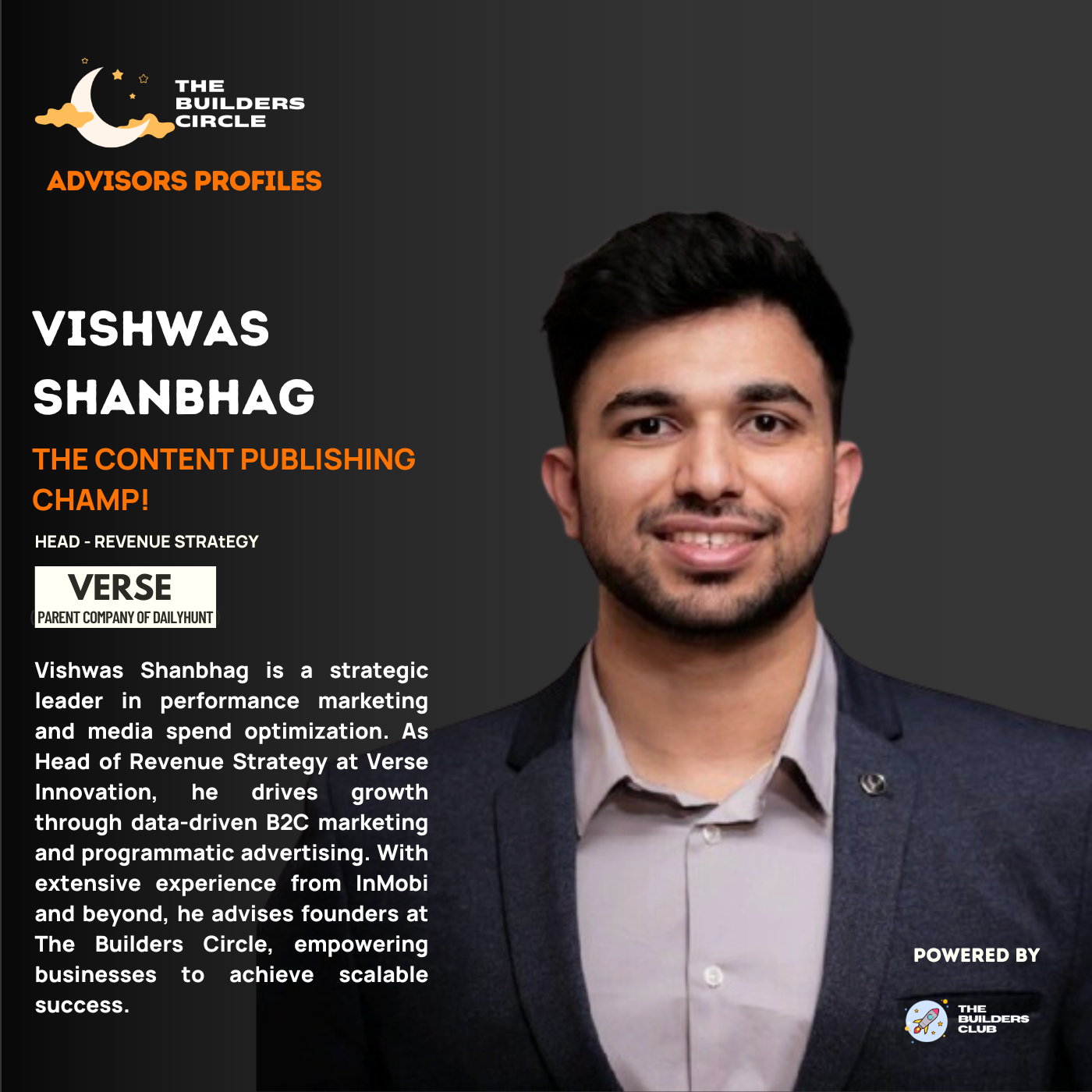
Vishwas Shanbhag: A Story of Strategic Growth, Innovation, and Empowerment

Advertisement

Vishwas Shanbhag: A Story of Strategic Growth, Innovation, and Empowerment

, ,

In the fast-evolving world of digital advertising and media, Vishwas Shanbhag stands as a beacon of innovation and strategic acumen. His journey from navigating the complexities of programmatic advertising to leading revenue strategy at a tech giant like Verse Innovation (parent company of Dailyhunt) is a tale of relentless focus and determination.

A Trailblazer in B2C Marketing and Media Strategy

Vishwas’s expertise spans more than six years, with a proven track record in programmatic ads, media spend optimization, and driving ROI-focused performance marketing. His ability to blend creativity with data-driven strategies has positioned him as a thought leader in the digital marketing space.

Currently serving as the Head of Revenue Strategy at Verse Innovation, Vishwas has played a pivotal role in crafting performance marketing strategies that fuel growth. His efforts have not only elevated brand visibility but have also maximized media spend efficiency, ensuring resources are allocated where they generate the most impact.

Before his time at Verse Innovation, Vishwas honed his skills at InMobi, one of the leading names in mobile advertising. His experience there deepened his understanding of the mobile ad ecosystem, making him a powerhouse of knowledge in navigating both B2C marketing and digital advertising landscapes.

Key Advisory Expertise

Vishwas’s advisory strengths lie in:

  • Performance Marketing
  • B2C Marketing Strategies
  • Programmatic Advertising
  • Media Spend Optimization

For founders seeking to scale their businesses through strategic media and marketing efforts, Vishwas offers invaluable insights into making data-driven decisions and optimizing performance.

Achievements and Accolades

Vishwas’s career is marked by several notable achievements. His innovative strategies and leadership have earned him recognition in the digital advertising community. From spearheading impactful campaigns to driving significant revenue growth, his contributions have been celebrated within the industry.

His awards and honors reflect not just professional excellence but also his ability to inspire and lead teams toward achieving ambitious goals. Vishwas’s story is one of resilience, strategic foresight, and a passion for helping businesses thrive in an ever-competitive landscape.

A Mentor for Growth-Stage Founders

Now, as a member of the CXO Advisory Panel at The Builders Circle, Vishwas is channeling his expertise to guide founders on their growth journeys. His deep understanding of B2C marketing and media spend management will help founders make informed decisions, maximize ROI, and leverage programmatic advertising to its full potential.

The Builders Circle is more than just a network—it’s a close-knit community of founders who collaborate, support one another, and benefit from the insights of experienced advisors. Vishwas’s presence on the panel strengthens this collective effort to drive meaningful business growth.

Why Vishwas’s Story Matters to Founders

Vishwas’s journey is a compelling reminder that strategic thinking, coupled with relentless execution, can drive extraordinary outcomes. His insights into performance marketing and media strategy are invaluable assets for any founder looking to scale efficiently and sustainably.

For founders seeking mentorship, Vishwas’s story offers not just inspiration but also a blueprint for success in today’s digital economy.

Join The Builders Circle: A Community of Innovators

The Builders Circle is an exclusive offline community for growth-stage founders who are committed to scaling their ventures with the support of peers, advisors, and partners. With leaders like Vishwas Shanbhag offering mentorship and guidance, members gain access to powerful resources for growth and collaboration.

We are currently onboarding 10 founders who meet the criteria of being either funded or generating an ARR of over ₹1 crore. If you’re ready to accelerate your growth journey and tap into a network of visionary leaders, click the link to register and join this transformative community.

Be inspired by Vishwas Shanbhag’s journey. Join The Builders Circle and unlock your potential for growth and success.

Click here to register and start your growth journey now!

Advertisement
Advertisement
Facebook
X
LinkedIn
Land and Expand: Western Tech vs. Tier-1 Indian Enterprises

Dissecting the ‘Land and Expand’ Thesis: Upsell Velocities Inside Western Tech Companies vs. Tier-1 Indian Enterprises

Land and expand works in both markets, but the engine is different. In Western tech companies, expansion follows usage and seat growth. In Tier-1 Indian enterprises, expansion follows trust and new approvals. Forecasting both with the same upsell curve will overstate one and understate the other. This post explains the mechanics so you can plan a realistic expansion path. What is the land and expand model? Land and expand means winning a small initial deal, proving value, then growing contract value through more users, modules or business units. Its success is measured by net revenue retention, discussed in McKinsey’s research on NRR in B2B tech. Note: public benchmarks on upsell velocity by geography are scarce. Treat the comparisons below as structural patterns and use your own cohort data. How does expansion happen inside Western tech companies? Usage-triggered growth. Teams add seats or tiers as adoption spreads. Budgets are often held by team leads. Self-serve upgrades. Smaller expansions may not need a new procurement cycle. Faster internal referrals. Peer teams within the same company often adopt tools they see colleagues using. How does expansion happen inside Tier-1 Indian enterprises? Approval-triggered growth. Each new business unit may need its own sponsor, budget and sometimes a fresh security review. Relationship-led referrals. A senior leader introducing you to another division is worth more than usage data alone. Group-level frameworks. Once you are an approved group vendor, onboarding additional entities can become faster, which is where the expansion curve steepens. Lumpy rather than linear. Expansion often arrives as a step change after a successful quarter or leadership review. Expansion velocity compared: Western tech vs Tier-1 Indian enterprises Factor Western tech company Tier-1 Indian enterprise Expansion trigger Usage and seat growth New sponsor, new division, new approval Early pace Faster, often incremental Slower, often step-wise Long-run potential Capped by company size and seat count Can be large across group entities Main accelerator Product adoption Executive sponsorship and group vendor approval Main risk Downgrades and consolidation Stalled approvals between divisions How do you build an expansion plan that fits the market? Define the expansion map at landing. List every division, entity and use case that could adopt the product. Turn the first win into a reference. A short, approved case study is portable across divisions. Get group-level approval where possible. A master agreement or empanelment can shorten later onboarding. Assign an expansion owner. Do not leave growth to support staff. Forecast in stages. Model Indian expansion as step changes tied to approvals, not as a smooth monthly curve. When should you stop investing in an account? If, after two quarters, you still have only one sponsor, no group-level visibility and no referral, expansion is unlikely. Shift effort to accounts with multiple advocates. FAQ What is land and expand in enterprise SaaS? It is a model where a vendor wins a small first contract, proves value and then grows revenue through more users, modules or business units. Success is measured by net revenue retention. Is land and expand slower in India? Early expansion is often slower because each division may need separate approvals, but it can accelerate sharply once you are an approved group vendor with senior sponsors. How do I plan an upsell forecast for Indian enterprises? Model expansion as step changes linked to specific approvals, new divisions and executive reviews. Use your own historical cohorts rather than a generic monthly growth rate. Conclusion Land and expand is a durable strategy in both markets, but the triggers differ. Western accounts grow with adoption. Indian enterprise accounts grow with trust and approvals. Plan the expansion map before you land, and forecast in steps. Want to learn how other founders expanded across Indian business groups? Join The Builders Club. References and further reading McKinsey: The net revenue retention advantage in B2B tech Harvard Business Review: The risks of prioritising short-term revenue over customer fit Harvard Business Review: Winning the right customers isn’t just a sales issue Gartner: The B2B buying journey and how to optimise it NASSCOM-Frost: Enterprise digital transformation About the author: Sohail Khan is Founder and Director of The Builders Club, a professional community of 35,000+ founders and CXOs across India, UAE, Singapore and the US.

Read More »

The Paid Pilot Showdown: Do Proof-of-Concepts Convert Better in Western Markets or Indian Enterprises?

A paid pilot is not a free trial with an invoice. It is a commercial test with a pre-agreed definition of success. In many Western markets, buyers are used to paying for pilots and expect a go or no-go decision at the end. In many Indian enterprises, pilots are still run as free evaluations that drift for months with no clear path to a contract. Here is how the two approaches differ, why conversion rates are hard to compare, and how to run a pilot that actually ends in a signature. What is a paid pilot, and how is it different from a PoC? A proof of concept (PoC) tests whether something is technically possible. A paid pilot tests whether it creates business value in a real environment, with real users, under a commercial agreement. The word “paid” matters because payment forces a budget owner, a scope and a decision date. Without those, a pilot becomes a long free service. Note: there is no reliable public dataset comparing PoC-to-contract rates between Western and Indian enterprises. The patterns below come from how buying processes typically work, so measure your own conversion rate and treat it as your benchmark. How do pilots typically run in Western markets? Budget exists for experimentation. Innovation or departmental budgets often fund pilots, so charging a fee is accepted. Success criteria are written down. Metrics, timelines and the decision-maker are agreed before kickoff. Procurement has a pilot template. Many large buyers have standard pilot or evaluation agreements, which shortens legal time. Outcome is a decision. Convert, extend with conditions, or stop. How do pilots typically run in Indian enterprises? Free evaluation is the default expectation. Teams often ask vendors to prove value before any money moves. Sponsor is clear, budget is not. The business head may love the pilot, while the commercial approval sits elsewhere. Scope expands quietly. Extra integrations, extra users and extra reports get added without changing the commercial terms. Timeline is relationship-led. Decisions follow internal bandwidth, leadership changes and budget cycles, not just pilot results. Western vs Indian pilots: where do conversion rates diverge? Dimension Typical Western enterprise Typical Indian enterprise Pilot fee Commonly accepted Often resisted; may be credited against the contract Success criteria Documented up front Often verbal or evolving Decision owner Named budget holder Sponsor plus a wider approval chain Main failure mode Pilot succeeds but loses to priorities Pilot drags on without a decision Best protection Clear exit criteria Commercial conversion terms signed first The key insight is that conversion depends less on market and more on pilot design. A well-structured pilot in either country converts better than a loose one. How do you design a pilot that converts in India? Agree on the business problem, not the feature list. Write the one metric the sponsor will defend internally. Set a fixed duration. Typically 4 to 12 weeks, depending on integration depth. Put an end date in writing. Charge something. If a full fee is not possible, charge a partial fee that is credited against the first-year contract. Even a nominal commitment signals seriousness. Pre-agree the conversion path. State the commercial terms that apply if success criteria are met, so the next step is a signature rather than a new negotiation. Name every approver early. Identify IT, security, finance and procurement stakeholders while the pilot is running, not after. Hold a formal readout. Present results to the sponsor and the decision-maker together, with a clear recommendation. What are red flags that a pilot will not convert? No budget owner has attended a single meeting. The success metric keeps changing. Requests for new features appear mid-pilot with no change in scope or fees. The sponsor cannot name the next approval step. FAQ Should Indian startups charge for pilots? Wherever possible, yes, even partially. A paid or credited pilot filters out casual evaluations and pushes the buyer to identify a budget and a decision-maker. If a fee is impossible, require a signed pilot agreement with success criteria and a conversion clause. How long should an enterprise pilot last? Most pilots work best between 4 and 12 weeks, based on integration complexity. Longer pilots often lose momentum. Set a fixed end date and a decision meeting in the calendar before you start. What is a good PoC-to-contract conversion rate? There is no universal benchmark. Track your own rate across your first 10 pilots, split by whether they were paid, credited or free. That internal comparison is more useful than any generic industry figure. Conclusion Pilots convert when they are designed as commercial decisions. Define success in writing, attach a fee or credit, fix the timeline, and agree on the conversion path before the first login. Do that, and the Western-versus-Indian gap narrows considerably. Want pilot templates and peer advice? Join The Builders Club to learn how founders structure pilots with large enterprises. Join the community. About the author: Sohail Khan is Founder and Director of The Builders Club, a professional community of 35,000+ founders and CXOs across India, UAE, Singapore and the US.

Read More »