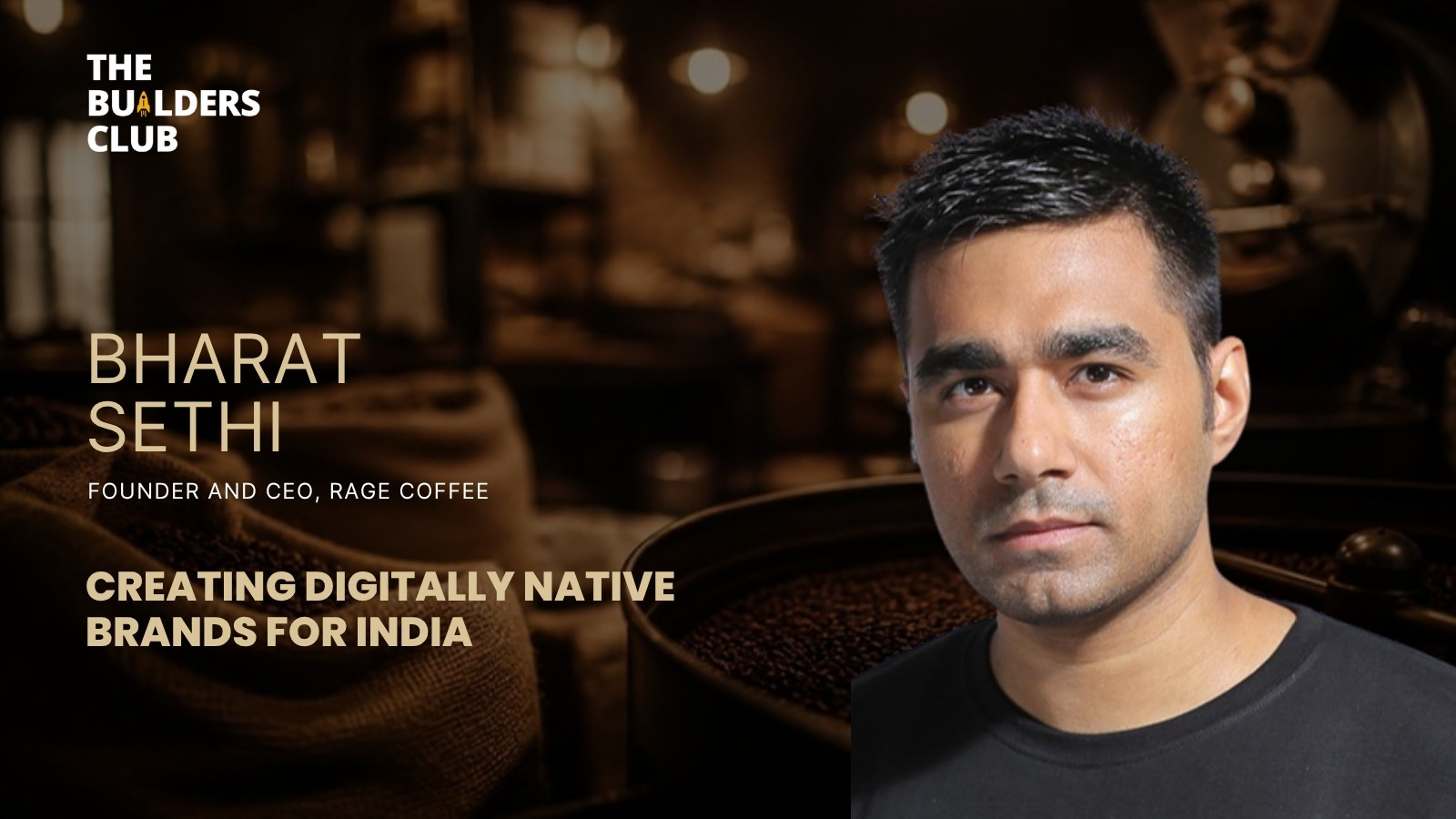
Coffee is a commodity that people spend 15 minutes a day with, and Bharat Sethi saw a brand in that habit. Rage Coffee was designed from day one as a digitally native FMCG company aiming for a very large scale.
In this episode, the serial entrepreneur explains how he chose a category, why D2C is not just online selling, and what young founders should do before they ever pitch an investor.
How do you build a digitally native brand in FMCG? Bharat Sethi’s approach
Bharat’s approach starts with a big ambition and works backwards. He set a goal of building a 500 crore annual recurring revenue company by 2025, then picked a category and sub-categories to own, and a sequence of audiences to win.
He treats D2C as a digital mindset: data-driven decisions across product, marketing, retention and distribution. Online is a way to learn and acquire customers, but he sees the future as omnichannel.
- D2C is a mindset. Digital DNA matters more than selling only online.
- Work backwards from the goal. Pick a category, then own sub-categories and audience segments one by one.
- Validate with customers first. Talk to users before you chase investors.
- Keep marketing simple. Pick one channel, do it well and repeat it for a long time.
What does D2C really mean for a consumer brand?
Bharat says people misread D2C as selling online. For him it is about having a digital mind: using data to understand the consumer, develop products, acquire customers and retain them.
He points out that online shopping reaches only a limited portion of the market, so a brand that wants scale cannot ignore offline distribution. Rage Coffee thinks digitally but is omnichannel, and a distributor in a smaller city who wants the product is not turned away.
The real power of direct-to-consumer, in his view, is the narrative: why should someone consider buying you before they even transact.
Why did Bharat Sethi choose coffee and FMCG?
After exiting earlier businesses, Bharat spent a quarter talking to founders, trade partners, distributors and consumers. He kept a notebook of ideas and chose the intersection of a personal passion, coffee, and a large market.
He wanted a digital-first FMCG company, so he worked backwards from the revenue goal. He looked for a complex, competitive category that still had room to grow, and then for sub-categories he could own.
His planned audience sequence was coffee aficionados, then fitness enthusiasts, then gamers, then corporate professionals.
- Set a five-year target and plan backwards
- Own sub-categories inside a large category
- Win one audience segment at a time
How do you spot a real opportunity and not a false blind spot?
Bharat argues that outsiders can disrupt because insiders cannot see past what they were taught. In coffee, the team bought tiny quantities at first and insiders would have laughed at that, yet the product found a segment that valued flavours, convenience and a distinct caffeine level.
He also warns that not every blind spot is a big market. Niche gaps can look attractive but cap out, so validation matters.
What did Rage Coffee offer that was different?
He describes a cafe-style flavoured coffee with 90 to 120 mg of caffeine and low calories, aimed at people who care about fitness and function. The positioning is an inspirational coffee brand rather than a plain drink.
- Flavour that competes with speciality coffee
- Simplicity and convenience at home
- Functional benefits such as low calories and stated caffeine content
- Affordability
How should a founder think about brand building?
Bharat calls brand building the ultimate packaging of a product, driven by what the founder believes. You find a gap, build a fundamentally different product and stay true to why you started.
Only after that do colours, logos, taglines and segmentation come in. He says a brand cannot be forced on people, and that marketing and brand go hand in hand, because marketing something that is not a real brand falls flat.
On influencers, he and the host distinguish positioning from distribution: influencer marketing is a channel, while the value proposition is the positioning.
- Find a real gap
- Build a differentiated product, not a copy
- Stay true to your philosophy
- Then design the visual identity and segment the audience
What marketing and go-to-market advice does he give?
His advice is blunt: marketing is simple. Choose one channel, do it exceptionally well, and keep doing it for a long time.
On the product side, he says a bad product with good go-to-market fails, and so does a good product with poor go-to-market. He recommends a decent product and a strong go-to-market, and warns that launching what you believe is fully finished is a mistake because the market will surprise you.
What does he say about funding and angel returns?
Bharat cautions founders against assuming that raising money solves problems. He notes that venture deals are scarce relative to the number of founders chasing them, and that building for users first is the safer path.
On revenue-based financing, he says it can help a scaling consumer business with well-understood unit economics, but it should supplement equity, not replace it, and it is expensive when contribution margins are negative.
He also defended D2C for angel investors, saying he has returned money to his own angels and that angels can see strong multiples, while noting that returns are capped as consumer brands scale.
- Talk to customers before investors
- Use revenue-based financing only with proven cost structures
- Expect capped but real returns from consumer brands
Further reading and sources
- Direct-to-consumer marketing on Wikipedia
- Fast-moving consumer goods on Wikipedia
- Omnichannel on Wikipedia
Frequently asked questions
Is D2C only about selling online?
Bharat says no. He defines D2C as a digital mindset applied to product development, marketing, retention and distribution. Online is a strong starting channel, but he sees the future as omnichannel.
When should a startup consider revenue-based financing?
Bharat sees it as a supplement to equity for businesses with proven cost structures and healthy contribution margins. If margins are negative or acquisition costs are high, the cost of capital becomes too steep. It suits founders who want working capital without dilution.
How do I know whether to drop a startup idea?
Bharat suggests talking to at least three or four people who would be paying customers. If they say they will pay, continue; if they signal it is not worth their time, discard the idea. For products, let people try and rate them, and ask what they would pay.
Conclusion
Bharat Sethi’s message is to start with a bold goal, then stay disciplined about validation, simple marketing and a clear brand philosophy.
If you are planning a consumer brand, define your first audience, test the product with real customers, and pick one acquisition channel to master before adding more.
Want more conversations like this? Join The Builders Club, our community of 35,000+ founders and CXOs, and explore more episodes of the Startup Founders Podcast.