
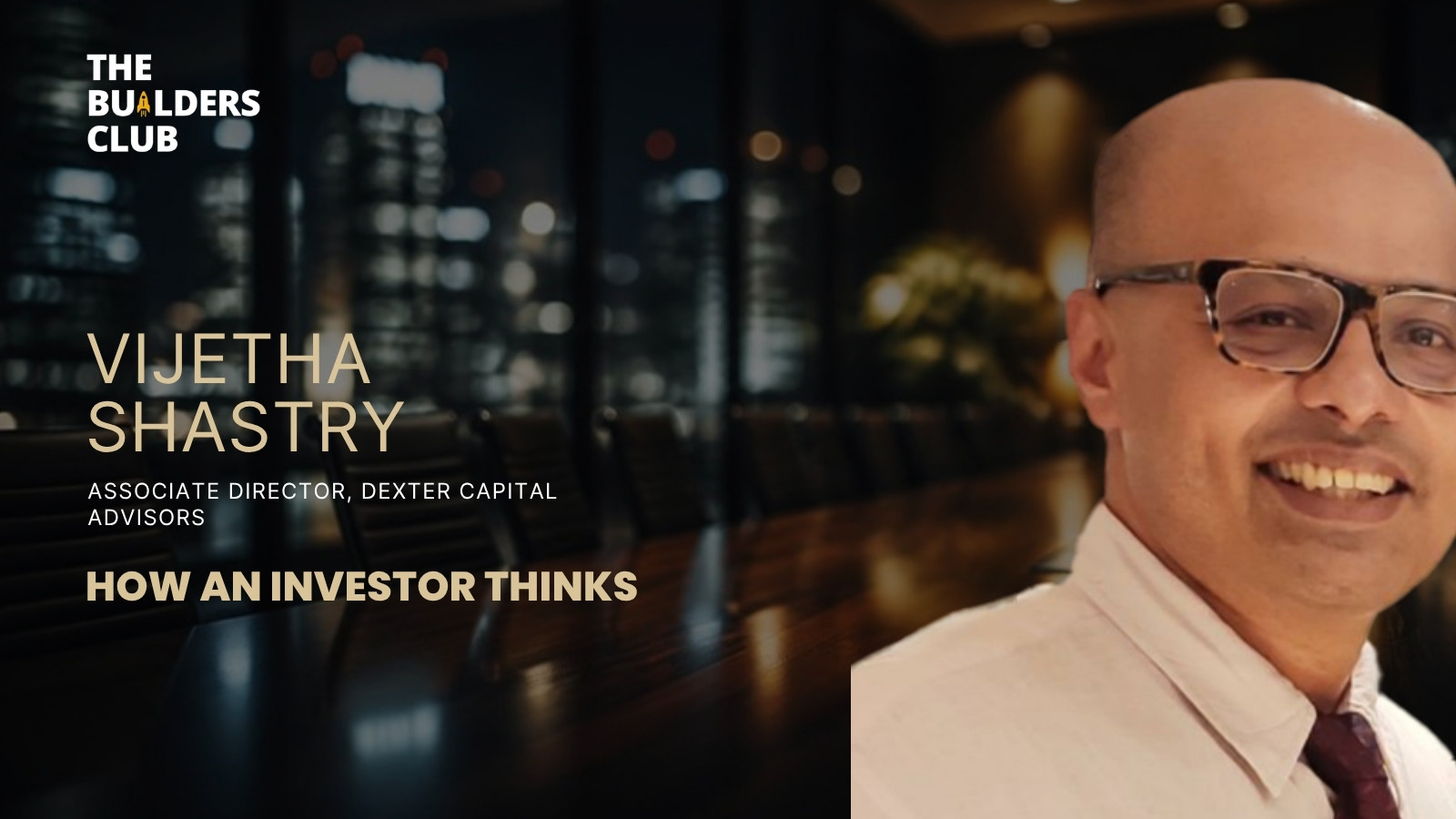
Every founder has been told no by an investor and wondered why. Vijetha Shastry has spent close to three decades around startups, from NASSCOM and TiE to Headstart, and now works on the investor side at Dexter Capital and Dexter Angels.
In this episode he explains how an investor thinks, what they check before writing a cheque, and what founders keep getting wrong.
How does an investor think? Vijetha Shastry’s core thesis
Investors make money only when there is an exit, so almost every decision traces back to that. Vijetha’s advice is to look at your startup through the investor’s eyes: the team, the size of the sector, regulation, and whether the business can plausibly scale beyond one city.
A no is rarely personal. Usually the company simply does not fit that fund’s thesis, stage or existing portfolio, and good venture capital investors are also answerable to the people whose money they manage.
- Exits drive everything. Funds return money to their own backers, so they back companies with a credible path to a follow-on round or exit.
- Research the investor first. Theses, portfolios and stages are public; spraying every fund wastes a founder’s scarce time.
- Due diligence is deep. Expect checks on the founders, customers, partners and sector risks.
- Do the basics properly. Register the company, keep clean legal paperwork and show real customer proof.
What do investors look for in a founder and a startup?
Vijetha says investors start with the founding team and the size of the market, then ask whether this team can actually address it. They will talk to alumni networks and people the founder may not even know are being called.
He also stresses global ambition. A business built only for a small city rarely produces the large exits that investors need.
- The founding team, its reputation and whether it can handle stress
- Market size, and a real USP or moat, not just a big addressable market
- Regulation and policy risk, especially in fintech, crypto and Web3
- Governance and compliance, including diversity and environmental goals at many funds
How does a VC fund make money and why does that matter to founders?
A VC fund is a bit like a startup: it raises money from limited partners such as family offices, pension funds and institutions, then invests it over several years. A small share goes to management fees, and profits above that become the fund’s carry.
Because funds must return capital in a few years, even patient investors have a clock. Vijetha notes that funds also specialise, so each one behaves differently.
- The fund raises capital from family offices, HNIs, pension funds and others.
- It invests across a portfolio in tranches over several years.
- Exits and follow-on rounds return money to backers.
- A track record lets the fund raise its next fund.
How should founders approach the right investors?
His strongest message is against a spray-and-pray approach. If a fund only backs D2C, a SaaS founder is wasting everyone’s time, and an early-stage fund will not answer a request for a very large cheque.
He suggests a one-pager plus a longer deck, and talking to founders already in the investor’s portfolio.
Where does the research come from?
Most of it is public: fund theses, portfolios, published industry reports and events. Reports from consulting firms and bodies like NASSCOM are useful for understanding where funds are looking.
- Read the fund thesis and the existing portfolio
- Check if the fund already backs a competitor
- Network at demo days and community events
How do you reach a fund?
You do not always need the general partner. A partner or principal can take your pitch to the analysts, who dig into the sector and ask for MIS and information.
How do early-stage founders handle advisors, legal basics and pre-orders?
In the live Q&A, Vijetha repeatedly warned founders to get the basics right. He told one founder to build a checklist before seeking an advisor, involve a lawyer, link compensation to milestones and avoid handing out too many advisory shares that can hurt the next round.
To another founder, he said to register the company first, open a current account and treat unpaid pre-orders as weak proof. Real advances or payments carry more weight.
- Draft a checklist of what you need from an advisor
- Use contracts and NDAs, and tie rewards to outcomes
- Register the company before taking money
- Raise from family and friends before thinking about Series A
Should founders chase speed and scale or profitability?
There is no single answer, in his view. He pointed to recent examples of blitzscaling backfiring and said scaling with poor-quality customers fails under due diligence, because retention, unit economics and runway get checked.
The skill is reading the market: expand rapidly when cash, customers and unit economics are strong, and conserve cash when conditions in your sector are weak.
Do investors compete with each other?
Companies compete, but investors usually collaborate. A lead investor typically takes a large share and brings in others for the rest, and everyone wants the best founders and the best terms.
Vijetha adds that term sheets and shareholder agreements are critical documents, and funding usually arrives in tranches linked to milestones.
Further reading and sources
Frequently asked questions
What is the main thing investors want from a startup?
A credible path to an exit. Investors make money when there is a follow-on round or sale, and they must return capital to their own backers. That is why they look closely at team, market size and scalability.
How do I find the right investor for my startup?
Research funds’ public theses, stages and portfolios, and only approach those that match your sector and stage. Talking to founders in their portfolio and attending community events also helps. Avoid mass-emailing every fund.
Why do investors say no even when the idea is good?
Often it is fit, not quality. The startup may be outside the fund’s sector or stage, overlap with an existing portfolio company, or lack proof such as paying customers. A no is not necessarily a verdict on you.
Conclusion
Vijetha’s message is to think from the investor’s side: understand their incentives, research before you reach out, and show proof, not promises.
Before your next conversation, write your one-pager, shortlist five matching funds and tidy your legal basics.
Want more conversations like this? Join The Builders Club, our community of 35,000+ founders and CXOs, and explore more episodes of the Startup Founders Podcast.