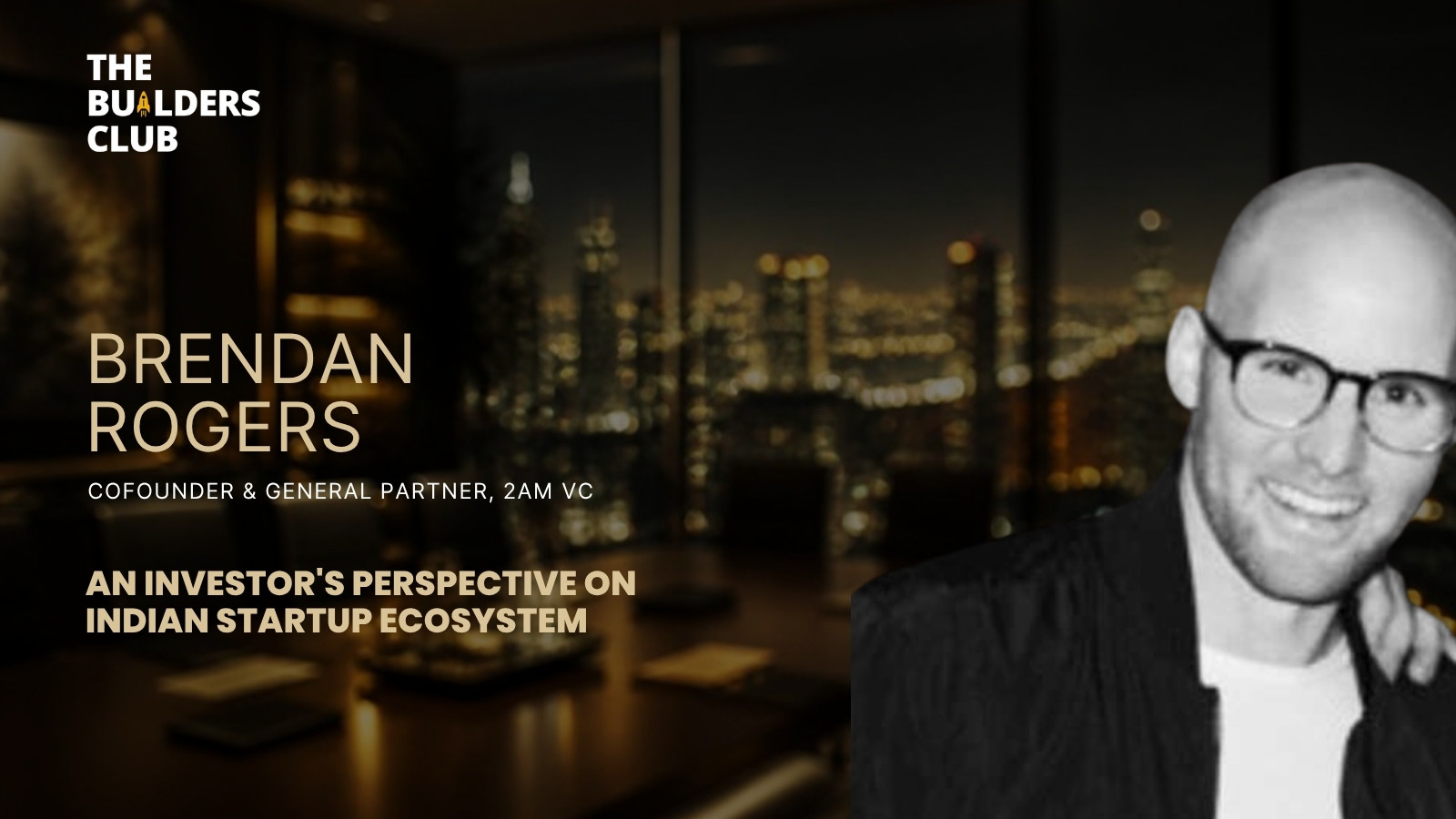
What does an investor actually look for when a pre-seed deck lands in the inbox? Brendon Rogers, co-founder of 2am VC, answers without the usual polish.
A Wag co-founder turned India-focused seed investor, Brendon joined The Builders Club to talk about backing young founders, vetting investors in return, and the habits that win early deals.
How do seed investors evaluate startups? Brendon Rogers’ framework
Brendon says there is little data at pre-seed and seed, so the decision rests first on the founder and second on the size of the market. A business can be good and still not be venture backable if its scope is too small.
After that, he does his own research and leans on local angels and funds who have already done diligence. Much of the final call, by his own account, is intuition about whether the founders could fall down and get back up.
- Founder first. Team background and tenacity come before everything else.
- Market size matters. Venture capital needs a big enough total addressable market.
- Be different, with proof. A crowded space needs a clear edge such as faster growth or a unique acquisition channel.
- Ask for advice, not money. Relationships built on feedback convert better than cold fundraising pitches.
How did Brendon Rogers go from Wag to 2am VC?
Brendon grew up in Rhode Island and moved to Silicon Valley after college. His first company was a social dating app on Facebook, whose assets were eventually acquired.
He then co-founded Wag, an on-demand dog-walking platform, after studying the market and testing the idea with people on the street. He wanted a transactional business with high retention and lifetime value. A trip to Mumbai for a 100x.vc demo day convinced him to build a fund for India.
Why does 2am VC back Gen Z founders in India?
The fund is Gen Z focused but not limited to that group. Brendon argues that India has a huge young population, and founders from that cohort build quickly for users who will grow with their products.
He cites macro trends he saw first-hand: cheap mobile data and the rise of UPI. He also liked that few Indian funds were led by former founders, which he felt would help him relate to the people he backs.
- The name reflects the 2 a.m. crises founders face, from bugs to lawsuits.
- His view is that investors should stay with founders well beyond the cheque.
What do investors look for at pre-seed and seed?
Brendon’s sequence is team, market size, then his own market and competitor research, backed by the network. Because most deals include other well-known investors, their diligence helps.
- Understand who the founder is and what their background shows.
- Test whether the total addressable market is big enough for venture returns.
- Research competitors and validate the trend with trusted local operators.
- Check who else is investing and move quickly if conviction is high.
What if a well-funded competitor already exists?
He wants to know what makes the new startup different: faster growth, a unique acquisition channel or a smoother product. He noted that Facebook was not the first social network, but it had an edge.
How should founders sell a long-term vision?
A vision needs a story about how the team will execute it, backed by roadmap, team experience or proprietary technology. Simply promising to become the biggest company in a category is not convincing.
How should founders choose and approach investors?
Founders often treat investors as a source of money alone. Brendon suggests asking what value they bring from day one, such as industry introductions, hiring help or technical advice.
At the fund level, he prefers partners who have been founders themselves. He also encourages founders to be shameless about reaching out on LinkedIn or Twitter.
- Match angels to your sector, for example e-commerce operators for an e-commerce startup.
- Fill skill gaps, such as a technical angel if the founders are non-technical.
- Open with a request for feedback. His line: when you ask for money you get advice, and when you ask for advice you get money.
What makes a good pitch deck and how do you win over talent?
Brendon prefers a short pitch, a light deck and an appendix for detail. His preferred outreach is a brief email with the team, investors and traction, with the deck attached.
On hiring people smarter than you, he recommends selling the mission, using signals such as investors or accelerators, and telling a story. The best Wag hires, he said, were pet owners who felt the problem personally.
- Keep slides short on text: problem, vision, solution and team.
- For capital-intensive ideas, look at accelerators, grants or a cheaper first version.
- Student founders who raise venture money are expected to commit full time.
Further reading and sources
Frequently asked questions
What do seed investors look at when there is no revenue?
They focus on the founder’s background and tenacity, the size of the market and any early traction or usage. Brendon Rogers also leans on trusted local experts and co-investors for validation.
How long should a startup pitch deck be?
Brendon recommends keeping the pitch under about two minutes and the deck light on text: problem, vision, solution and team. Details can go in an appendix for later conversations.
How do I approach an investor without sounding desperate?
Start by asking for feedback on what you are building and share your background. Building a relationship first tends to convert better than leading with a request for money.
Conclusion
Brendon Rogers’ advice reduces to a few habits: pick the right founders and markets, show an edge, and treat investor relationships as two-way diligence.
Before your next outreach, rewrite your intro as a short feedback request and list what each prospective investor can add beyond cash.
Want more conversations like this? Join The Builders Club, our community of 35,000+ founders and CXOs, and explore more episodes of the Startup Founders Podcast.