
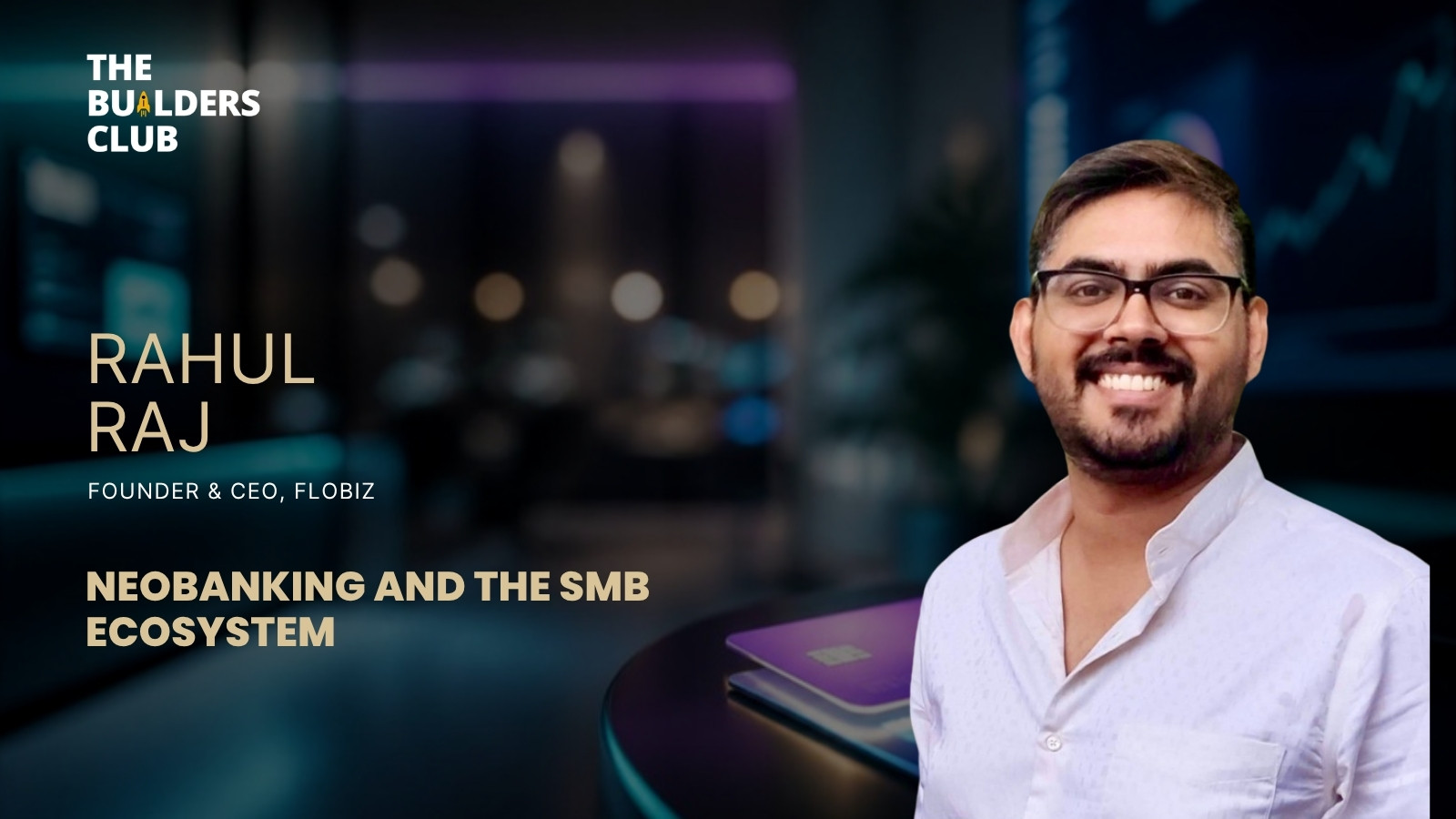
Rahul Raj went from running an online food delivery business inside the IIT Kharagpur campus to co-founding one of India’s biggest crypto exchanges, and then to building software for millions of small businesses.
In this episode of The Builders Club Startup Founders Podcast, the FloBiz co-founder explains why neobanking for SMBs starts with something far humbler than a bank: a simple billing app.
What is neobanking for SMBs? Rahul Raj’s software-first path to credit
Rahul’s core thesis is that small businesses must become digital before they can be banked or lent to. FloBiz started with MyBillBook, a GST billing and accounting app designed for the business owner rather than the accountant, and only later moved toward banking and working capital.
His sequence is digital first, then digital payments, then digital credit. In his view, the data from daily invoicing is what lets a company offer the right financial product to the right business at the right time.
- Software is the entry point. Billing and accounting get a small business online; banking and credit follow.
- Distribution beats features. Technology is easy to copy, but fast distribution and product stickiness build a moat.
- Segment before you scale. FloBiz targets GST-registered businesses because compliance forces them to adopt digital tools.
- Match capital to purpose. Raise money for clear strategic goals, and focus on unit economics early.
How did Rahul Raj get from a campus food startup to FloBiz?
Rahul joined IIT Kharagpur in 2011 and found the entrepreneurship cell in his first year. He then built the campus’s first online food delivery business, which expanded to Kharagpur town and won a government MSME grant.
Scaling it in Hyderabad showed him how much on-ground infrastructure the model needed, so he and his co-founder wrapped it up. After short stints at Inshorts and Bizongo, where he was the first product manager, he teamed up with two colleagues who shared his interest in blockchain.
- Campus food delivery: an early lesson in operations-heavy businesses.
- Bizongo: first exposure to small manufacturers and a mentor.
- The crypto bet: three colleagues quit their jobs in early 2017 to build an exchange.
What did building and losing a crypto exchange teach the founders?
The team launched CoinX in August 2017 as an open order book, KYC-compliant exchange, writing the whole stack themselves. By December 2017 Rahul says it was handling more than 265 million dollars in daily trade volume, with the team sleeping at the office most nights.
In April 2018 the RBI directive cut crypto off from formal banking channels, and the fiat business became unsustainable. The founders looked at going global or building institutional blockchain infrastructure, judged both too hard, and chose to move on rather than force it.
Why they chose SMBs next
After about six months of research in 2019, the small business opportunity stood out. Rahul cited roughly 30 percent of GDP, 45 percent of formal employment and 42 percent of exports coming from small and medium businesses, while most of them still ran on pen and paper.
How do you build software that small business owners actually adopt?
MyBillBook launched on Android in January 2020, because most small business owners have a phone but not a laptop. The team treated early customers as champions, listened constantly, and built features iteratively.
Rahul notes that customers typically use only the most critical 20 to 30 percent of features. The onboarding flow reflects this: users pick an invoice theme and create a sample invoice first, which delivers an early moment of value.
- Segment the market into early adopters, the undecided and the sceptical, and sell to them in that order.
- Target GST-registered businesses, where compliance already forces digital records.
- Ride timing waves such as GST and e-invoicing.
- Offer regional languages and a call centre, and digitise inventory from Excel files, bills or photos.
Can Indian SMBs pay for SaaS, and how should you price it?
A common belief was that Indian small businesses would not pay for software. FloBiz ran its first pricing experiment in June 2020 at 500 rupees a year, and customers paid.
Through continued pricing and go-to-market experiments, Rahul says the product now sells for 12,000 to 15,000 rupees a year. The company is moving to add-ons and tiered plans, which also raise average revenue per user. He reported 6.5 million registered businesses and around one million monthly active users.
- Launch a paid plan early to test willingness to pay.
- Keep running pricing and go-to-market experiments.
- Add tiers and add-ons as the product deepens.
- Shift focus to unit economics once you have scale.
What is a defensible moat for a startup in a fast-moving market?
Rahul argues that technology alone rarely differentiates, especially with low-code and no-code tools making an MVP easy to build. The defensibility he points to is distribution and stickiness.
He uses UPI apps as an example: once a user is on one app, they rarely switch. Innovation then lets you add adjacent products that deepen the relationship with the same customer.
Should founders bootstrap or raise venture capital?
Rahul says it depends on the business. A service business can start with only time, while an insurance or NBFC business needs capital by regulation.
He describes FloBiz’s funding as a 3 million dollar first cheque from Green Oaks, a 10 million dollar round led by Elevation, and a 31 million dollar round led by Sequoia Capital’s growth arm, for about 44 million dollars in total. Beyond cash, he values the network and access that investors such as Sequoia Capital bring.
- Raise for a clear purpose such as M&A, a new market or a new business line.
- Build unit economics early so you keep leverage in a downturn.
- Treat fundraising as a step, not the destination.
Further reading and sources
- FloBiz and MyBillBook official site
- Goods and Services Tax (India) on Wikipedia)
- Unified Payments Interface on Wikipedia
- Sequoia Capital on Wikipedia
Frequently asked questions
What does FloBiz do for small businesses?
FloBiz builds technology to help small and medium businesses grow. Its flagship product, MyBillBook, is a GST billing and accounting app, and the company is expanding into banking and working capital solutions.
Why start with billing software instead of lending?
Rahul Raj says businesses must be digital before they can be banked or lent to. Invoicing data shows the state of a business, which lets a company offer relevant credit at the right time.
How should I choose a customer segment for an SMB product?
Pick the segment with a natural reason to adopt, as FloBiz did with GST-registered businesses that must keep digital records. Sell first to early adopters, then expand to the undecided and sceptical groups as the product matures.
Conclusion
Rahul Raj’s story is a reminder that a failed venture can sharpen the next one. The crypto exchange ended with a regulatory shock, but the research discipline and team carried into FloBiz.
For founders serving small businesses, the takeaway is to build software they will adopt, price it honestly, win on distribution and stickiness, and add financial services only once the data and trust are in place.
Want more conversations like this? Join The Builders Club, our community of 35,000+ founders and CXOs, and explore more episodes of the Startup Founders Podcast.