
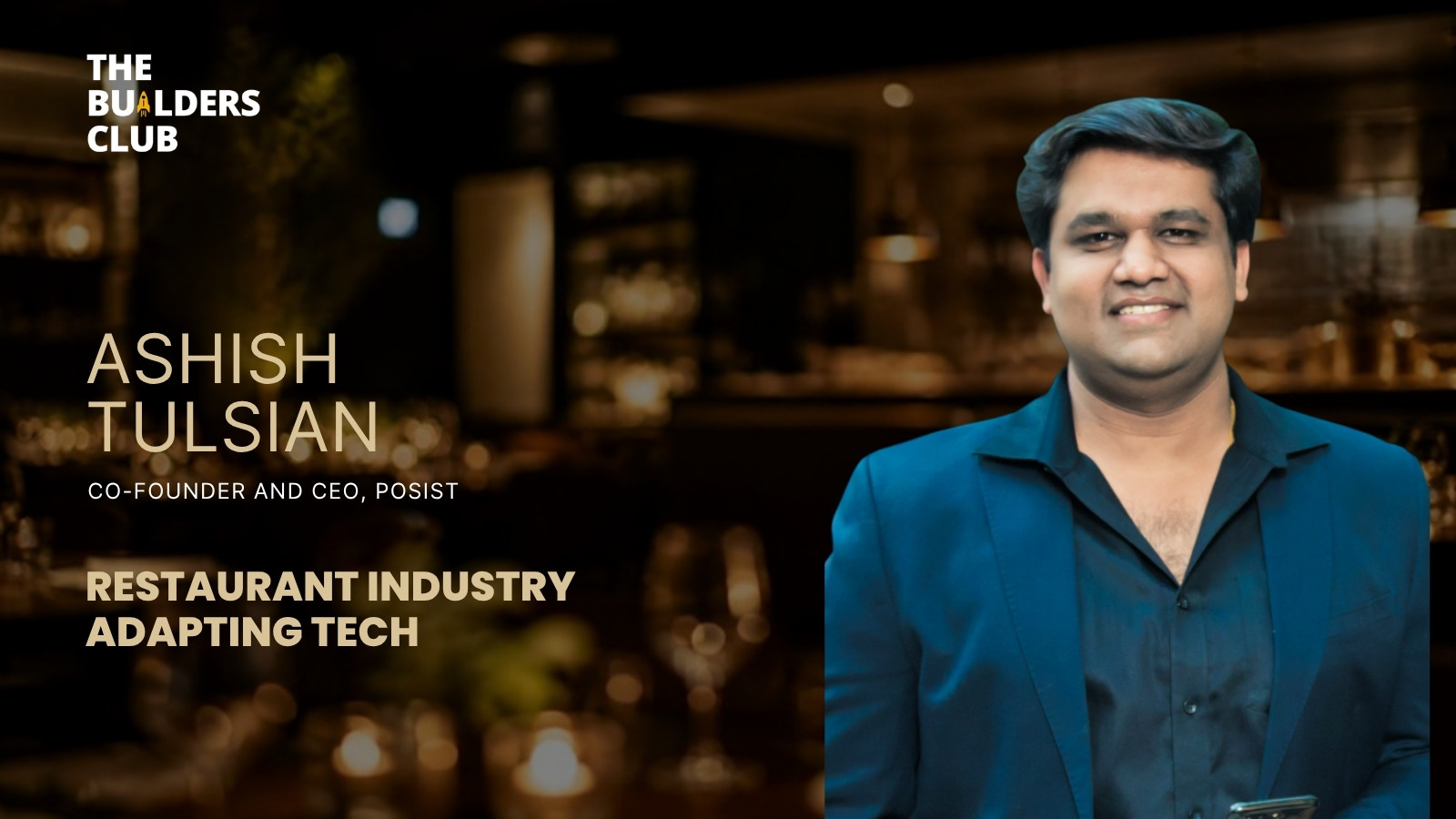
Atul Tulsian once spent his school summer holidays pretending to be a grown-up client of a web agency, with his father sitting in as a stand-in. Years later he co-founded POSist, a cloud-based platform used by restaurant chains across many countries.
In this Builders Club water cooler conversation, he shares what it takes to build restaurant technology in a market that first has to be educated, and why he says no to many customers.
What does it take to build restaurant technology? Atul Tulsian’s core thesis
Atul’s thesis is that in an early market the real job is education, not selling. POSist was a browser-based product with offline capability at a time when most restaurants used legacy desktop billing, so the team had to convince owners that cloud POS was worth having.
He also argues for a deliberate premium position: fewer customers, higher prices, strong service, and inbound demand built through content.
- Educate before you sell. Early years were spent explaining why a restaurant needs cloud software at all.
- Welcome competitors. He says new entrants helped educate the market and drove a large share of growth.
- Choose premium on purpose. POSist declines customers who only want discounts.
- Specialize deeply. The team grew from a POS into 18 products, all for the restaurant space.
What is Atul Tulsian’s founder journey before POSist?
Atul wanted to be an entrepreneur from school age. His first attempt, a web portal in class eight, never launched. In college he found a first paying customer for a small piece of software and learned the difference between selling a product and a service.
He later ran a telecom value-added services business from 2006 to 2011, relaying transaction SMS for financial companies, and sold it in 2011.
- Early ventures in web development and software services.
- A telecom SMS business that served banks and insurers.
- A restaurant he opened himself, which led to building POS software for it.
- POSist was incorporated in January 2012 and the restaurant was sold.
How did a restaurant problem turn into POSist?
Running the restaurant, Atul found that the day-to-day pain was operational. The team built software for their own outlet, but he checked each feature with other restaurateurs to avoid solving only his own problem.
He did not set out to sell the product at first. He only wanted to fix his restaurant, and the product-first mindset made the result generic enough to sell.
Why was it hard to sell cloud POS in 2012 to 2014?
The product ran in the browser and worked offline, which suited hot, busy kitchens where internet could fail. But the market had legacy desktop systems, often local products, and many owners had no interest in change.
He says 2012 to 2014 were the hardest years because the challenge was educating the market, not funding.
- Convince the owner that they need a POS at all.
- Convince them to use an internet connection.
- Convince them to let their data live in the cloud.
Who bought first?
Most early customers were the second or third generation joining a family restaurant and replacing a parent at the till with software.
How did competition and cloud kitchens change the market?
By 2015, POSist had about 800 restaurants. As online ordering platforms grew and new POS rivals appeared, Atul says he welcomed them, because they educated the market. He credits competitors with a large share of growth between 2015 and 2017.
Seeing demand for delivery-only operations around the end of 2018, the team built a cloud kitchen product in early 2019 and signed one of the largest cloud kitchen operators in the world, with a deployment in London in February 2019.
- Global expansion began around 2017.
- The product line expanded steadily after 2016.
- Customers told the team what to build, rather than a grand vision.
How did POSist recover from Covid?
Atul says April to June 2020 were very bad, and the company was bootstrapped with no investors to fall back on. The team kept services running and opened its cloud kitchen products to customers.
Atul described a steady recovery through the second half of the pandemic year, with revenue returning to pre-pandemic levels by December and a growing share of business coming from outside India.
- Zero customer churn he attributes to product and service.
- Brand equity built over years.
- A move into outbound sales, which grew into a significant share of the business.
What advice does he give about content, community and cloud kitchens?
On content, he says to educate rather than promote. POSist started its restaurant magazine blog in 2015 and, for the first three years, he tracked only repeat visitors and time spent.
On community, he suggests building one alongside selling, because most prospects will not convert, and a community keeps them engaged.
- Cloud kitchens can start with a relatively modest budget, though the real cost depends on cuisine, space and location.
- Operating costs are high, and he said most pure cloud kitchens were not yet profitable.
- Work in a restaurant for six months before opening one.
- AR and VR menus are gimmicky unless customers would miss them.
Further reading and sources
Frequently asked questions
How much does it cost to start a cloud kitchen in India?
Atul said setup costs can be modest, but they depend on cuisine, space and location. He warned that operating costs are high and many cloud kitchens were not yet profitable. Plan for running costs, not just setup.
Do small restaurants need a cloud POS system?
Atul said it depends on the stakes. A kitchen doing very few orders a day may not need a full platform, while one aiming for hundreds of orders needs efficiency tools. Buy when the value, such as inventory control or speed, clearly outweighs the cost.
Should I open a restaurant without industry experience?
Atul strongly advises against it. He suggests working in a restaurant for six months first to learn the economics, customers and delivery platforms at someone else’s cost. He opened one himself early on and says it taught him hard lessons.
Conclusion
Atul Tulsian’s lesson is that early markets reward patient education, honest focus and a clear choice on who you serve.
If you are building in a new category, plan to spend your first years teaching the market, and write content that helps rather than sells.
Want more conversations like this? Join The Builders Club, our community of 35,000+ founders and CXOs, and explore more episodes of the Startup Founders Podcast.