A source-by-source compilation of churn, net revenue retention and account expansion benchmarks for tech vendors selling to Indian enterprises, with the gaps in the data called out.


A source-by-source compilation of churn, net revenue retention and account expansion benchmarks for tech vendors selling to Indian enterprises, with the gaps in the data called out.
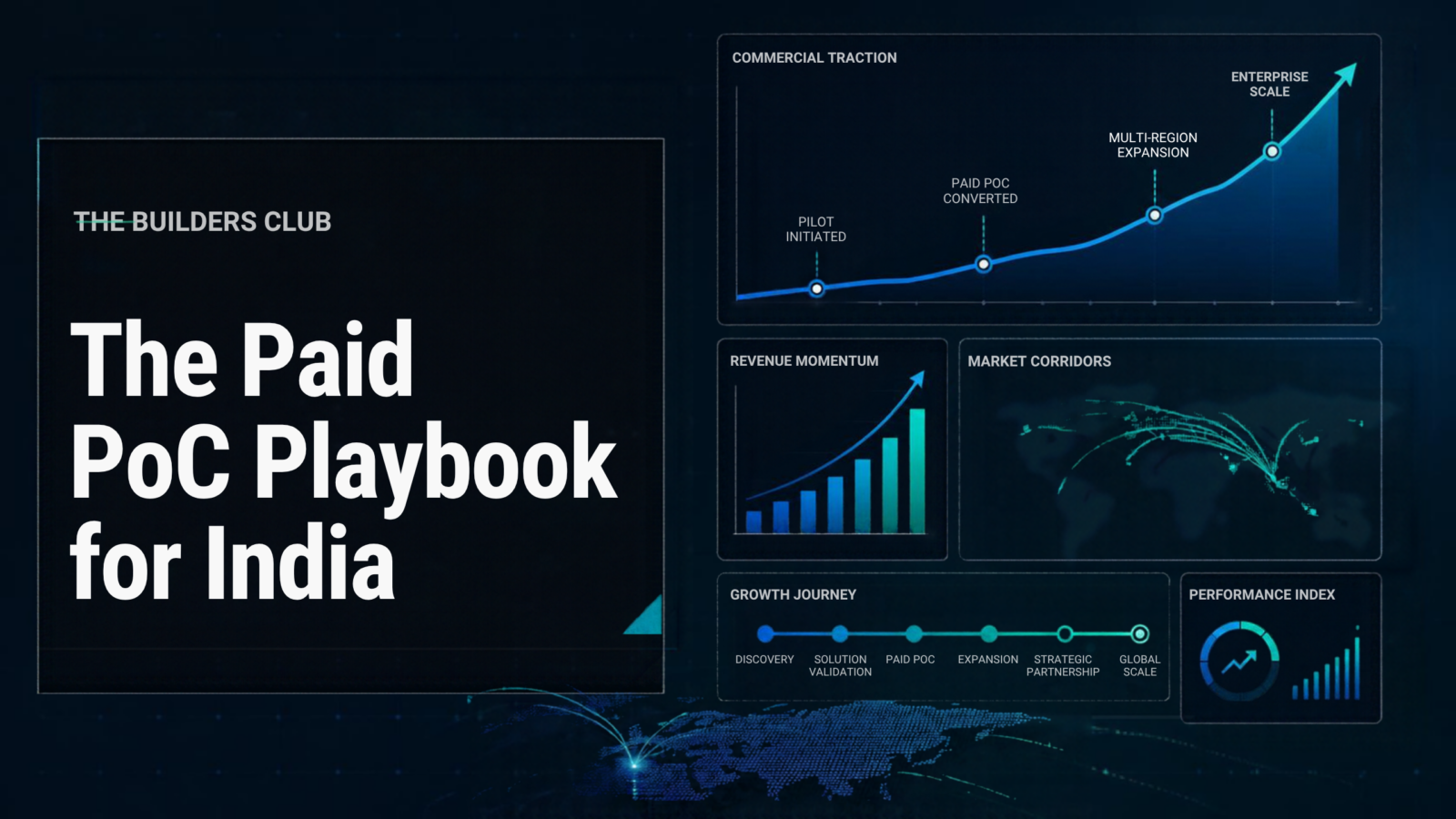
A phase-by-phase framework for running a paid proof of concept with Indian enterprise buyers: timeline, milestones, pricing models and conversion terms.
A Silicon Valley VP can usually sign inside a budget they own. An Indian family business promoter often holds the final say but delegates the evaluation, and that gap is where deals stall. Treating a friendly mid-level sponsor as the decision-maker is the most common mistake in cross-border enterprise sales.
Here is how the two models differ and how to secure a commitment that survives promoter review.
It is the assumption that the person championing your product has the authority to buy it. In US enterprise sales, a VP or director often does hold budget. In many Indian family-run groups, authority sits with the promoter or family council, while managers and professional CEOs run evaluations.
Academic work such as the Indian School of Business research on family business groups offers background on how these groups are structured.
| Factor | Silicon Valley VP | Indian family business promoter |
|---|---|---|
| Budget ownership | Often in the VP’s own budget | Often approved at group or promoter level |
| Who evaluates | The VP’s team | Managers, CIO or professional CEO |
| What builds trust | Data, ROI case, peer reviews | Personal credibility, references, introductions |
| Typical blocker | Competing priorities and budget timing | No access to the final decision-maker |
| Commitment signal | Signed order form | Promoter or senior leadership endorsement, then paperwork |
Work through the professional CEO or CIO, and ask them to describe what the promoter will want to see. Prepare that material in advance.
It varies, but for significant spend the final approval often rests with the promoter or a small family group, while managers and a professional CEO run the evaluation. Ask early who gives the final nod.
US VPs typically own a budget and follow a defined buying process. Promoters weigh trust, references and group-level considerations, so you need senior access and credible introductions.
Use warm introductions from mutual contacts, existing customers, advisors or community events. Ask your internal sponsor to request the meeting and prepare a short, outcome-focused briefing.
Do not mistake enthusiasm for authority. In the US, test whether your VP owns the budget. In Indian family groups, find the person who gives the final nod, and get there through trusted introductions and a promoter-ready summary.
Need warm introductions to promoter-led enterprises? Join The Builders Club.
About the author: Sohail Khan is Founder and Director of The Builders Club, a professional community of 35,000+ founders and CXOs across India, UAE, Singapore and the US.
How enterprise SaaS scale-ups turn free consultations into paid, annual contracts with leading Indian brands by packaging implementation as a clear commercial offer.
Grace periods, payment terms and late fees in Indian enterprise contracts: MSME rules, Section 43B(h), Section 74 and clause wording that holds up.
Self-serve PLG works when the user is also the buyer. In Indian enterprises, they almost never are. A product-led funnel can get your tool into a team’s hands, but it rarely gets a CXO to sign. The model that wins is a high-touch, assisted motion that uses product usage as proof, not as the whole sales strategy.
Here is why the standard playbook stalls in India’s large organisations, and what to run instead.
Product-led growth, as described by pioneers such as OpenView, assumes that users discover, try and adopt the product themselves, and that revenue follows usage. That assumption holds for tools with low risk, low price and individual buyers.
Enterprise buying in India breaks all three conditions at once.
It can work for teams, departments and SMB-sized units, where one manager has a card or small discretionary budget. It rarely scales to the top accounts without a human who turns usage into a business case.
Assisted does not mean old-fashioned. It means every stage of the product experience is paired with a person who removes a specific obstacle.
| Stage | Pure self-serve PLG | Assisted model for Indian enterprises |
|---|---|---|
| Discovery | Organic search, product trial | Warm introduction, peer room, referral |
| Evaluation | Self-guided trial | Guided pilot with named success criteria |
| Decision | User upgrades with a card | Business case built for the CXO and the committee |
| Contracting | Click-through terms | Negotiated MSA, security review, procurement |
| Expansion | In-app prompts | Account lead plans rollout across divisions |
Use the product as the evidence, and a person as the translator. A practical sequence:
Do not abandon it. Use self-serve as the top of the funnel and as a signal engine. Track which accounts have several active users, which teams invite colleagues, and which admins explore security settings. Those are the accounts your sales team should call first.
Think of it as product-qualified leads feeding a human-led close. Many global companies now run exactly this hybrid, and it fits Indian enterprise buying better than a pure self-serve approach.
No. PLG is useful for building awareness, usage data and champions inside accounts. It fails as the only motion for large enterprises, where committees, security reviews and relationships decide the contract. A hybrid model works better.
A PQL is an account or user whose in-product behaviour suggests buying intent, such as multiple active teammates or admin-level exploration. Sales teams use PQLs to prioritise who to approach with a human conversation.
It depends on deal size, but you typically need one senior owner for the relationship, one technical resource for security and integration questions, and a customer success lead after signing. Founders often cover the first two roles in early deals.
PLG gets you into the room, but it does not get a CXO to sign. In Indian enterprises, winning sales pair product evidence with human trust: a champion, a business case, a guided pilot and a senior conversation.
Building an assisted enterprise motion? Meet founders and CXOs who have done it at The Builders Club, and bring your toughest sales question to our next roundtable. Join The Builders Club.
About the author: Sohail Khan is Founder and Director of The Builders Club, a professional community of 35,000+ founders and CXOs across India, UAE, Singapore and the US.
How Indian CXOs judge software vendors: ROI timing expectations, a risk-adjusted ROI formula stress-tested with real overrun data, shortlisting criteria and a vendor proof scorecard.
A practical pricing and scope framework for B2B founders selling software to Indian enterprises, with a change-request process that protects margins.
US retention playbooks are built on product usage. Indian conglomerates renew on relationships, sponsor continuity and internal politics, so a healthy usage dashboard can still hide a churn risk. Founders who copy the US customer success model often see accounts go quiet, then disappear at renewal with no warning.
This guide compares how churn actually happens in the two markets and what to change in your retention system.
In the US, churn is usually signalled by falling usage, low adoption and unanswered success calls. Health scores, automated playbooks and quarterly business reviews are designed to catch these signals early.
In large Indian groups, churn is more often triggered by a change in people, budget ownership or group-level vendor policy. Usage can look fine while the real decision is being made in a room you are not in.
Note: there is no reliable public dataset comparing enterprise SaaS churn between the US and Indian conglomerates. The patterns below describe how buying and renewal typically work. Validate them against your own renewal history.
For a framework on why net revenue retention drives enterprise value, see McKinsey’s analysis of net revenue retention in B2B tech. The metric matters everywhere; what changes is the leading indicator you track.
| Dimension | US enterprise pattern | Indian conglomerate pattern |
|---|---|---|
| Main churn signal | Declining product usage | Sponsor change, budget reshuffle, vendor consolidation |
| Who renews | Department head with a defined budget | Business head plus IT, finance and procurement |
| Best early-warning tool | Health score and automated alerts | Named relationship owner and regular executive contact |
| Typical save play | Adoption campaign, training | Senior-to-senior conversation and a group-level value review |
| Renewal timing | Calendar-driven | Budget-cycle and approval-chain driven |
Add relationship and commercial signals: executive meetings held in the last quarter, number of active sponsors, approval status of the next renewal, and any open procurement or security reviews.
Renewal is often decided by people who do not use the product, such as business heads, IT and procurement. A sponsor change, budget cut or group-level vendor consolidation can end a contract regardless of usage.
Start 120 to 180 days before term end. Approval chains involve several functions, and late starts leave no time to resolve security, legal or commercial questions.
Yes for tracking adoption and tickets, but they need an added relationship layer. Pair them with named account owners, executive contact tracking and a record of every stakeholder in the approval chain.
Retention is a relationship problem as much as a product problem in Indian conglomerates. Keep your US-style usage analytics, then add stakeholder mapping, early renewal conversations and a named relationship owner for every large account.
Want to compare retention playbooks with founders who sell to Indian groups? Join The Builders Club.
About the author: Sohail Khan is Founder and Director of The Builders Club, a professional community of 35,000+ founders and CXOs across India, UAE, Singapore and the US.
A step-by-step roadmap for B2B tech founders to clear security reviews, legal vetting and compliance checks inside Indian enterprise procurement.