
How to build and manage an enterprise account sales team in India that grows beyond the founder’s personal network: roles, hiring timing, process and compensation.
How to build and manage an enterprise account sales team in India that grows beyond the founder’s personal network: roles, hiring timing, process and compensation.
How Indian enterprise CIOs audit legacy systems, decide what to keep, rehost or retire, and sequence cloud upgrades across conglomerate portfolios.

A practical guide to keeping proofs of concept paid, time-boxed and convertible: charter, guardrails, warning signs and how to end a PoC cleanly.
A UK mid-market firm and a Tier-1 Indian corporate house will both buy core infrastructure from you, but they will not pay, decide or expand the same way. UK mid-market deals tend to be smaller, faster and process-led. Indian group deals tend to start with a modest first contract and grow through relationships across divisions.
Founders who price both markets with one ACV assumption end up mispricing one of them. Here is how to think about the difference.
Annual Contract Value (ACV) is the average yearly revenue from a customer contract, excluding one-time fees. It is shaped by company size, buying authority, budget structure and how the buyer prefers to commit spend.
Two companies of similar revenue can have very different ACVs for the same product, because the buying behaviour, not the product, decides how much they sign at once.
Note: the comparisons below describe structural patterns, not published statistics. Validate every number against your own deal history before using it in a plan.
The buyer group in a UK mid-market company is usually smaller, with a CTO, head of IT or operations lead holding most of the authority. Procurement follows a defined process, and contracts are generally standardised.
Large Indian groups often operate as a portfolio of businesses under a shared brand. Technology decisions can sit with a central IT team, a group CIO, or the individual business heads, and sometimes all three.
| Factor | UK mid-market | Tier-1 Indian corporate house |
|---|---|---|
| Buying committee | Smaller, role-defined | Larger, spans IT, business, finance, legal |
| Sales cycle | Usually shorter once process starts | Often longer and less linear |
| Initial ACV | Capped by mid-market budgets | Often a small first step, such as one unit or pilot |
| Expansion path | Seats, modules, upgrades | Additional divisions, group entities, geographies |
| Negotiation focus | Compliance, SLAs, term length | Commercial structure, customisation, support |
| Biggest risk | Price pressure and churn | Stalled approvals and scope creep |
It depends on the segment, product and contract structure, and there is no reliable universal figure. In general, UK mid-market deals may close faster at moderate sizes, while large Indian groups can grow into bigger relationships over time through multi-division expansion. Compare using your own deal data.
Keep the core pricing logic consistent, but adapt packaging. UK buyers often prefer clear tiers and fixed terms. Indian enterprises may need flexible rollout phases, with the commercial structure explained in terms of business outcomes.
Choose based on your strengths. If you have a compliance-ready product and a repeatable process, UK mid-market can offer quick validation. If you have strong relationships and room to customise, a Tier-1 Indian group can become a long-term anchor account.
ACV is shaped by how a buyer commits, not just by what they buy. Plan UK mid-market deals around process and compliance, and Indian group deals around relationships and staged expansion. Use one pricing logic, but two go-to-market playbooks.
Selling across borders? Compare notes with founders and CXOs who sell in both markets. Join The Builders Club and get invited to our next roundtable.
About the author: Sohail Khan is Founder and Director of The Builders Club, a professional community of 35,000+ founders and CXOs across India, UAE, Singapore and the US.
The indemnity, liability cap and carve-out clauses that Indian corporate legal teams scrutinise in multi-year Master Service Agreements, and how B2B founders can prepare.
A source-by-source compilation of churn, net revenue retention and account expansion benchmarks for tech vendors selling to Indian enterprises, with the gaps in the data called out.
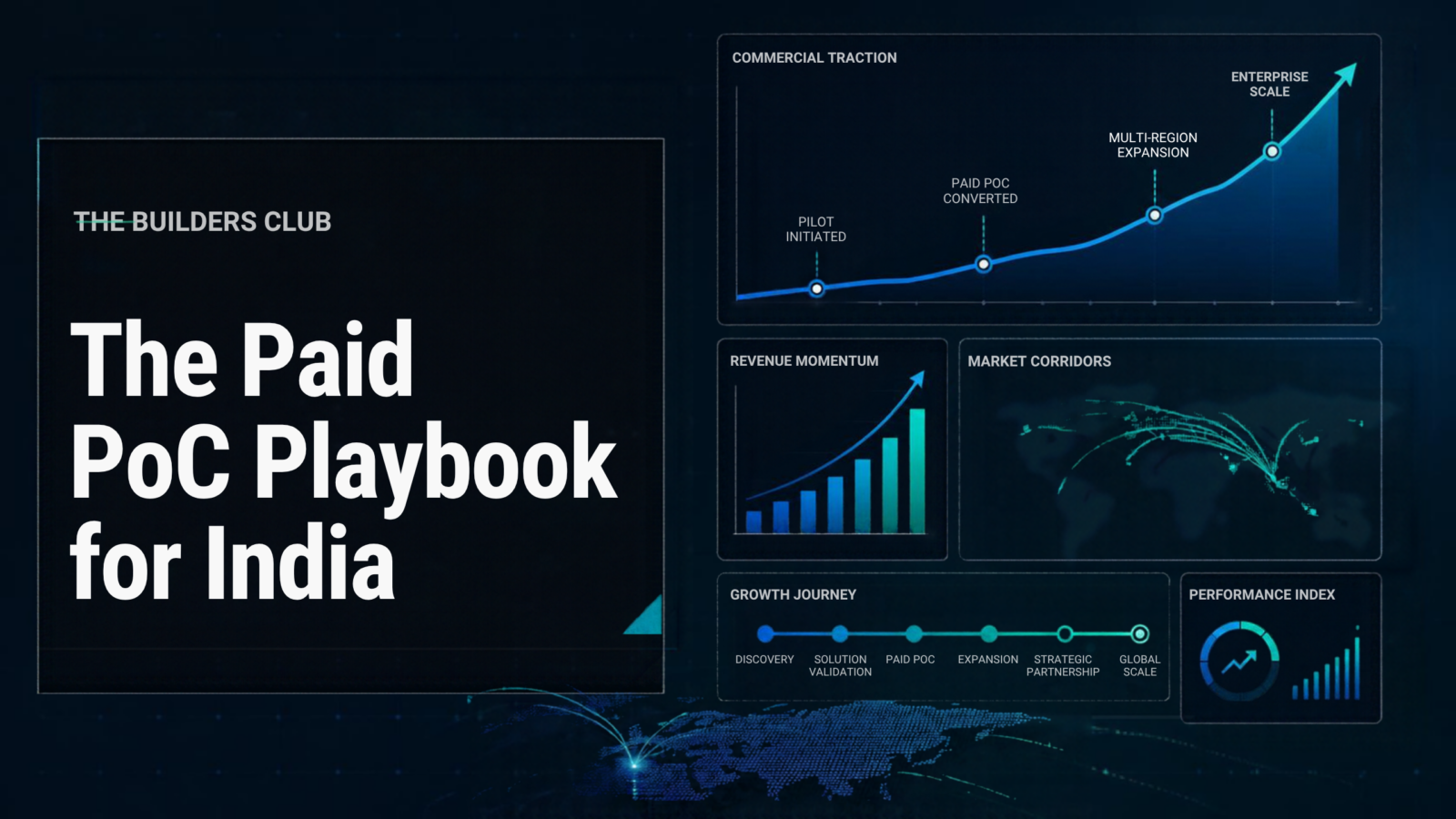
A phase-by-phase framework for running a paid proof of concept with Indian enterprise buyers: timeline, milestones, pricing models and conversion terms.
A Silicon Valley VP can usually sign inside a budget they own. An Indian family business promoter often holds the final say but delegates the evaluation, and that gap is where deals stall. Treating a friendly mid-level sponsor as the decision-maker is the most common mistake in cross-border enterprise sales.
Here is how the two models differ and how to secure a commitment that survives promoter review.
It is the assumption that the person championing your product has the authority to buy it. In US enterprise sales, a VP or director often does hold budget. In many Indian family-run groups, authority sits with the promoter or family council, while managers and professional CEOs run evaluations.
Academic work such as the Indian School of Business research on family business groups offers background on how these groups are structured.
| Factor | Silicon Valley VP | Indian family business promoter |
|---|---|---|
| Budget ownership | Often in the VP’s own budget | Often approved at group or promoter level |
| Who evaluates | The VP’s team | Managers, CIO or professional CEO |
| What builds trust | Data, ROI case, peer reviews | Personal credibility, references, introductions |
| Typical blocker | Competing priorities and budget timing | No access to the final decision-maker |
| Commitment signal | Signed order form | Promoter or senior leadership endorsement, then paperwork |
Work through the professional CEO or CIO, and ask them to describe what the promoter will want to see. Prepare that material in advance.
It varies, but for significant spend the final approval often rests with the promoter or a small family group, while managers and a professional CEO run the evaluation. Ask early who gives the final nod.
US VPs typically own a budget and follow a defined buying process. Promoters weigh trust, references and group-level considerations, so you need senior access and credible introductions.
Use warm introductions from mutual contacts, existing customers, advisors or community events. Ask your internal sponsor to request the meeting and prepare a short, outcome-focused briefing.
Do not mistake enthusiasm for authority. In the US, test whether your VP owns the budget. In Indian family groups, find the person who gives the final nod, and get there through trusted introductions and a promoter-ready summary.
Need warm introductions to promoter-led enterprises? Join The Builders Club.
About the author: Sohail Khan is Founder and Director of The Builders Club, a professional community of 35,000+ founders and CXOs across India, UAE, Singapore and the US.
How enterprise SaaS scale-ups turn free consultations into paid, annual contracts with leading Indian brands by packaging implementation as a clear commercial offer.
Grace periods, payment terms and late fees in Indian enterprise contracts: MSME rules, Section 43B(h), Section 74 and clause wording that holds up.
