
A Date With An Investor: How We Got Founders and VCs Talking Over Coffee — No Pitch Decks Allowed
A Date With An Investor is one of The Builders Club’s most loved and most unique initiatives. The premise is simple but rare: we hand-pick a small group of founders whose company resonates with a specific investor’s thesis, and we put them in the same room — usually the investor’s own office, over coffee and conversation.
No slides. No panels. No 60-second elevator pitches. Just 4–5 carefully curated founders and an investor having a real, high-context conversation about building, raising, and scaling. Founders apply against each investor’s published funding criteria, so every person in the room is genuinely relevant to the fund — and the investors get to meet a shortlist of startups that actually match what they’re looking to back.
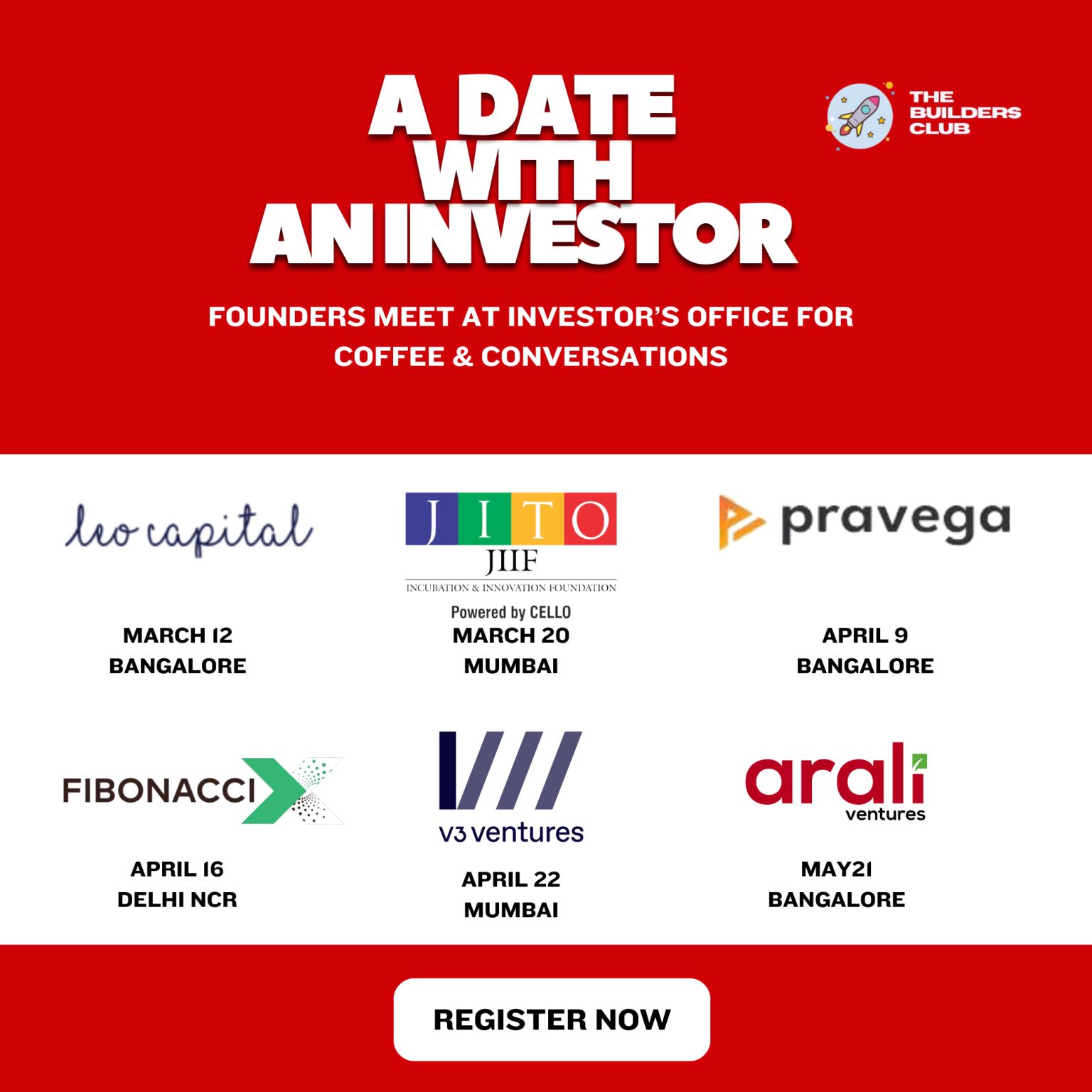
Across this series we partnered with some of India’s sharpest early-stage funds — Ideaspring Capital, Leo Capital, JITO, Pravega Ventures, Fibonacci X, V3 Ventures, Signal Ventures, She Capital and Arali Ventures — across Bangalore, Mumbai and Delhi. Here’s how it unfolded.
The Line-Up: Dates With Investors Across Delhi, Mumbai & Bangalore
We announced the season with a full slate of investor dates — each fund mapped to a clear thesis so founders could register against the right one. The format stayed constant throughout: 4–5 founders, the investor’s office, coffee and conversation. No pitch decks, only discussions.
View this post on Instagram
1. Ideaspring Capital — Bangalore
The thesis: Ideaspring Capital is a deep-tech-focused fund that writes cheques ranging from $1 million to $3 million for MVV+ (minimum viable venture) startups.
This edition was uniquely curated — The Builders Club carefully shortlisted startups based on their founding thesis, ensuring a high-quality, high-relevance engagement for everyone in the room. Here are the highlights:
View this post on Instagram
2. Leo Capital — Bangalore
The thesis: Leo Capital invests an average cheque size of $1–3M in B2B Enterprise Tech.
- Industry: B2B Enterprise Tech
- Stage: ARR > $100K
- Where: Bangalore, at the investor’s office
4–5 founders got the opportunity to meet the team over coffee and conversations — no pitch decks, only discussion.
View this post on Instagram
3. JITO Incubation & Innovation Foundation — Mumbai
The thesis: Sector agnostic. JITO Incubation & Innovation Foundation joined the series in Mumbai, open to founders across industries — the same intimate, office-table format, built around real conversation rather than a formal pitch.
4. Pravega Ventures — Bangalore
The thesis: Pravega Ventures backs B2B Enterprise Tech with cheque sizes of $1–5M.
- Cheque size: $1–5M
- Industry: B2B Enterprise Tech
- Stage: ARR > $100K
We brought five curated founders into an unstructured, high-context, founder-first conversation — no slides, no panels, just real talk. The founders who joined: Srijan Jain (DexyAI), Dhiraj Jain (DotKonnekt), Manohar C. (Parentof), Vijay H Madhusudan (Evate Technologies), Dax Percey Abraham (Videoit.io) and Ayush Agrawal (Kubo Care). The best part? Two founders found instant synergy and started collaborating.
View this post on Instagram
5. Fibonacci X — Delhi NCR
The thesis: Fibonacci X runs a 6-month, scope-based, non-cohort accelerator for startups building in the GenZ & Alpha industry, or with a Bharat-focused story. They love being the first investor on your cap table.
- Theme: Gen Z, Gen Alpha, Middle India (Bharat)
- Industry: Agnostic
- Stage: Early-stage
- Traction: INR 50L – 1Cr ARR
- Investment size: INR 25L – 1Cr
This Investor Date was part of the Fibonacci X 6-month accelerator — designed for startups building for Bharat and the broader industrial ecosystem. Five founders joined: Dev Tyagi (CTO, Codefancy Lab), Saurabh Singhai (CEO, CB Business Solution), Siddhant Aggarwal (Luxid Tech), Vivek (Luxid Tech) and Vikrant Shome (Founder & CEO, AcadSpace Technologies). Rather than a typical pitch session, it was an open floor for honest, cross-questioned feedback from peers and investors alike.
View this post on Instagram
6. V3 Ventures — Mumbai
The thesis: V3 Ventures backs Consumer Tech & Consumer Brands with cheques of $1M–$5M, from Seed to Series A.
- Investment size: $1M – $5M
- Focus areas: Consumer Tech & Consumer Brands
- Stage: Seed to Series A
Five early-stage founders came together for a closed-door conversation on building from 0 to 1 — navigating PMF, GTM pivots and all the chaos in between. Thanks to Anmol Mahajan, Anoushka Rele, Joshua Salins, Karan Sharma and Tejas Bhamare for joining, and to Arjun Vaidya and Abhiram Bhalerao from V3 Ventures for showing up not just with capital, but with conviction, empathy and game-changing perspective.
View this post on Instagram
7. Signal Ventures
The thesis: Signal Ventures backs disruptive, early-stage startups — leading and co-leading rounds at the Seed / Pre-Seed stage.
- Stage: Seed / Pre-Seed (leads & co-leads rounds)
- Sectors: Consumer, Health-tech, Media-Tech
- Avg cheque size: ₹75 Lacs – ₹1.25 Cr
- Valuation focus: Sub ₹50 Cr (≈ $6M), up to $10M in exceptional cases
Only 4–5 founders got the chance to meet Signal Ventures at their office — an exclusive opportunity to pitch, gain insights and connect over coffee, with a shot at funding, mentorship and strategic investor perspective.
View this post on Instagram
8. She Capital — Delhi
The thesis: She Capital is India’s leading fund for high-growth, women-led and co-led startups with the vision and capability to scale globally. Having already backed 14 startups — including Ellementary, Brainsight and Clovia — they champion the future of inclusive entrepreneurship.
- Focus areas: Consumer, Retail, Sportstech, Deeptech, AI
- Minimum criterion: Revenue positive
- Minimum ticket size: ₹1 – 2 Cr
For this closed-door mixer in Delhi, we curated a group of five dynamic women founders — two joining virtually from Mumbai and Bangalore. From early traction to scaling bottlenecks and GTM pivots, each founder laid out her journey candidly, met with high-quality, actionable feedback and peer learning. One standout conversation came from Polish Me Pretty, who offered a sharp lens into the Q-commerce space.
View this post on Instagram
9. Arali Ventures — Bangalore
The thesis: Arali Ventures backs B2B founders with cheques of $500K–$1M.
- Stage: $100K+ ARR for SaaS, early traction for others
- Sectors: SaaS, Marketplaces, Deeptech, Fintech, Industry 4.0
- Cheque size: $500K – $1M
This was one of our most insightful editions yet. In an intimate, highly curated setting, eight handpicked founders got the rare opportunity to pitch their startups — not just to investors, but to each other. Each founder presented, took questions and received real-time feedback on everything from GTM to positioning. A few soft introductions to potential clients and advisors were even made right in the room. For Arali Ventures, it was an efficient way to meet highly relevant founders aligned with their thesis — all in one session, under one roof.
View this post on Instagram
More Such Dates Coming Soon
A Date With An Investor is more than a pitch event — it’s an interactive founder–investor roundtable designed to help founders refine their story, gather actionable feedback, and build meaningful relationships with both peers and investors. It’s where founders get seen, heard and supported, with real outcomes and a real community behind them.
If you’re a founder looking to sharpen your narrative, or an investor looking to meet promising early-stage startups without the noise — we’re building exactly for you. We’re just getting started.